We invite you to explore this page to understand how Allegheny County is using settlement funds to address the opioid epidemic.


In 2021 and 2022, states and localities reached historic settlements with manufacturers and distributors of opioids, as well as pharmacy chains and a consulting firm, for their roles in the opioid epidemic. As a result of these settlements, Allegheny County will receive annual payments in varying amounts, every December, through at least 2038.

Two major objectives guide Allegheny County’s use of opioid settlement funds:

  • reducing fatal overdoses
  • reducing the harms from opioid use disorder

The flexible nature of the settlement funds compared to other funding streams strengthens Allegheny County’s ability to:

  • provide stability for effective existing programs, especially when other funding is uncertain or inadequate
  • expand effective services and build capacity—such as covering upfront operational costs—that Medicaid or other healthcare funding does not cover
  • support emerging strategies and fund innovative solutions aimed at addressing the opioid epidemic

Dashboard and Reports

The dashboard and reports—housed on this page—track the use of settlement funds and document the outcomes of the investments.

    1. 2024 Opioid Settlement Fund Report (Published 2025): describes the County’s strategy to address the opioid epidemic and the programmatic investments made with opioid settlement dollars in 2024.
    2. Opioid Settlement Community Listening Sessions Findings: reports the results and findings from community listening sessions held in 2024. Community priorities for opioid settlement spending included: expanding treatment access, reducing harm and stigma, improving housing stability and investing in family strengthening supports and services.
    3. Opioid Settlement Dashboard (2022-Present): displays an interactive dashboard that tracks Allegheny County’s spending of opioid settlement funds across different programs and priorities.

Previous:

    1. 2023 Opioid Settlement Fund Report (Published 2024): details how Allegheny County used it’s first installment of opioid settlement funds.

Key Takeaways

  1. Decrease in fatal overdoses: There was a 35% decline in fatal overdoses from January to August 2024 compared to the same period in 2023 (301 compared to 466).
  2. Decline in wastewater levels for norfentanyl and xylazine:
    1. The concentration of norfentanyl (a proxy for fentanyl) in wastewater dropped by more than 60% from March 2024 through the end of December 2024.
    2. The concentration of xylazine (a drug often used in veterinary medicine as a sedative) in wastewater levels had a sharp decline over the course of 2024, falling over 80%.
  3. Expansion of treatment in jail: The total count of individuals receiving any medication for opioid use disorder (MOUD) in the jail more than doubled from 2023-2024—from 889 to 1,800.
  4. Growth of mobile and telehealth treatment access:
    1. Mobile units operated by Prevention Point Pittsburgh (PPP) served 600 patients in high need communities at no cost.
    2. Telemedicine services offered by the UPMC Bridge Clinic—a fast turnaround MOUD prescribing service—had over 2,000 encounters in 2024, and most patients accessed medication within two hours of their telehealth visit.
  5. Support for community-led solutions: In 2024, Allegheny County dedicated nearly $1 million in settlement funds to support initiatives led, designed or operated by highly impacted communities.
  6. Investments in harm reduction strategies: In 2024, syringe services reached 700 new visitors and 3,000 returning visitors. The service program collected approximately 40 cubic feet of medical waste each month by collecting used supplies (e.g., needles, syringes) from visitors—supporting safe handling and disposal of medical waste in the community.
  7. Direction from the community: 2024 settlement investments reflected community input from the listening sessions—demonstrating Allegheny County’s commitment in shared decision-making.

How the County Uses this Information

Allegheny County uses the dashboard and reports to ensure it uses opioid settlement funds responsibly, equitably and effectively. Specifically, the County uses this information to:

  1. Monitor trends and outcomes in overdoses, treatment access and disparities across populations.
  2. Fill service gaps by directing funds to under-funded effective programs and by financing programs prioritized or endorsed by the community.
  3. Invest in evidence-based supports and services that support the improvement of current programs, the piloting of new initiatives and the design of innovative solutions.
  4. Drive continuous improvement efforts that strengthen partnerships and improve coordination across Allegheny County.
  5. Share insights and lessons learned with other communities and jurisdictions looking to pursue similar efforts.
  6. Strengthen public trust through advancing transparency in use of funds.

What’s Next

For 2025-2026, Allegheny County plans to use opioid settlement funds to:

  1. Expand access to low-barrier, high-quality, evidence-based MOUD and recovery support services.
  2. Continue to support treatment in the Allegheny County Jail, including continuity of care post-release.
  3. Increase services in highly impacted communities—improving mobile units for MOUD distribution and wound care, strengthening harm reduction services and enhancing targeted interventions for people at highest risk.
  4. Upgrade supportive housing by investing in recovery housing and permanent supportive housing for people with opioid use disorder.

Allegheny County has also issued a funding opportunity called the Open Solicitation for Programs that Prevent or Treat Opioid Addiction Under the Guidelines of the Opioid Settlement Fund. Through this Request for Proposals (RFP), Allegheny County seeks additional ideas from the community on how to improve outcomes for groups disproportionately or hardest impacted by the opioid epidemic, particularly the Black community, people who are currently or recently incarcerated, individuals experiencing homelessness, people who inject drugs, and people with chronic pain or disabilities.


Questions or Feedback?

We welcome your questions and suggestions. To share feedback, you can reach us at DHSResearch@alleghenycounty.us. If you’d like to stay informed, consider signing up for our newsletter. To learn how to use DHS data in your research, please visit our Requesting Data page. Thank you for your time and interest. Your engagement helps shape and improve how we share data that matters.


For many individuals, the intersection of substance use and incarceration reflects not a single bad decision, but the weight of systemic challenges, trauma, and unmet health needs. When the full range of treatments for opioid addiction are not available in correctional facilities, it can interrupt recovery and break the connection to care that individuals had available in the community.

Through partnerships between the Allegheny County Department of Human Services (DHS), the Allegheny County Jail (ACJ), and community-based providers, the County offers medication for opioid use disorder (MOUD) to individuals in custody. MOUD is widely recognized as the gold standard for treating opioid use disorder (OUD). This collaborative effort strengthens coordination between public health and justice systems and helps ensure continuity of care for people navigating both incarceration and addiction.

We invite you to explore this page to understand why MOUD in jail matters—and how communities can drive continued progress.

Dashboard and Report

The dashboard and report, available on this page, highlight both the scale of the MOUD program at the ACJ and the cross-system collaboration it took to make it work.

  1. The Medication for Opioid Use Disorder (MOUD) in the Allegheny County Jail (ACJ) Dashboard provides near real-time data on individuals receiving MOUD in the jail — including demographics, treatment timelines, prior access to care, and post-release connections to community-based services.
  2. From Barriers to Breakthroughs: Delivering Lifesaving Opioid Use Disorder Treatment to People in the Allegheny County Jail documents the County’s path to MOUD implementation— detailing operational hurdles, public engagement and the crucial role of opioid settlement funds (OSF). This report also highlights the perspectives and lived experiences of county staff, providers and jail officials.

Key Takeaways From 2024

  1. Program reach: Nearly 1,800 individuals received MOUD during their time in the ACJ—about as many people as the jail holds on any given day.
  2. Timeliness of care: 46% of individuals began MOUD within two days of entering the jail and 83% started within the first week.
  3. Reentry support: Over half of individuals leaving the jail connected with a community-based provider within three days.
  4. Decline in overdose fatalities: 17% of all fatal overdoses in Allegheny County involved individuals who left jail within the previous 12 months—a decrease from 19% between 2016 and 2020. Of those 2024 deaths, only 29% occurred within 90 days of release, compared to about 50% during earlier years. The timing of this decline aligns with expanded MOUD access and increased reentry support, suggesting that timely treatment may be helping to prevent overdose deaths.

How DHS Uses This Information

DHS uses the dashboard and report to monitor outcomes and drive system improvement. Specifically, DHS uses this information to:

  1. Track program implementation and spot disparities in access, timing, and outcomes
  2. Make decisions that improve coordination between the jail and community providers
  3. Use public funding—such as opioid settlement funds—responsibly and equitably to support what works
  4. Share insights and lessons learned with other communities and jurisdictions looking to pursue similar efforts

What’s Next

DHS will continue to use real-time data to strengthen reentry coordination, invest in peer support, monitor disparities across the system and guide ongoing improvements in care. Insights discussed inform decisions that make human services responsive, effective and equitable.

While Allegheny County remains one of the few jurisdictions in the country offering jail-based MOUD, it doesn’t have to stand alone. Opioid settlement funds are flexible and available nationwide, giving other communities the opportunity to build similar programs that support health, recovery, and continuity of care for people impacted by addiction and incarceration.

County staff, community providers and Jail leadership have worked together to show that even complex systems can deliver timely, effective treatment; their efforts lay the groundwork for broader change — turning short-term resources into long-term impact, demonstrating how local innovation can inform national progress, and building a foundation others can strengthen and carry forward.


Questions or Feedback?

We welcome your questions and suggestions. To share feedback, you can reach us at DHSResearch@alleghenycounty.us.
If you’d like to stay informed, consider signing up for our newsletter. To learn how to use DHS data in your research, please visit our Requesting Data page. Thank you for your time and interest. Your engagement helps shape and improve how we share data that matters.

Since 2022, the Allegheny County Jail Oversight Board (JOB) has approved monthly disbursements of $125 to individuals in custody from the Incarcerated Individuals Welfare Fund (IIWF). In 2024, the IIWF program provided more than $2.6 million to over 6,000 accounts for incarcerated individuals. These payments provide individuals in custody with funds that can cover expenses for phone calls, tablet use, commissary items and legal fess (e.g., fines, bail). Recipients can also save funds for use after release.

In January 2025, the JOB asked DHS to provide a descriptive analysis of the IIWF’s recipients and their use of the funds to inform future disbursement of the IIWF. Review the report to learn more about the IIWF—including who receives funds, how recipients spend funds and what impact the funds have on individuals’ outcomes post release.

Key Takeaways

Reach

  • Sixty-three percent of people in the ACJ in 2024 received at least one $125 payment from the IIWF during their stay. If the JOB were to disburse money more than one time a month, more people in the jail would benefit from receiving it.

Reliance

  • 1 in 5 IIWF recipients did not receive any other deposits in their account, underscoring the importance of the IIWF for individuals in custody who do not receive funds from families and friends outside the jail.

Spending Patterns

  • External deposits (from friends and family) did not decrease with the onset of the IIWF. 
  • For individuals who received funds in their first month at the ACJ, the IIWF lead to an increase in spending in every category of purchase—especially on commissary items.

Balance at Release

  • Among Individuals in the ACJ for one month or less
      • The median balance of IIWF recipients at release was $105 more than individuals who did not receive payments through IIWF.
      • IIWF recipients were almost 5x more likely to have a balance over $50 at release than non-recipients.
  • Among long stayers (individuals who stayed more than a month in jail):
      • After the implementation of the IIWF, the median balance at release grew from $4 to $60 and the share of individuals leaving the jail with at least $10 rose from 45% to 76%.

Post-Release Outcomes

  • Short-term outcomes—such as rebooking, emergency room use, shelter use, street homelessness—were not significantly different between individuals who left the ACJ with more than $75 and those who had no funds at release.


Questions or Feedback?

We welcome your questions and suggestions. To share feedback, you can reach us at DHSResearch@alleghenycounty.us. If you’d like to stay informed, consider signing up for our newsletter. To learn how to use DHS data in your research, please visit our Requesting Data page. Thank you for your time and interest. Your engagement helps shape and improve how we share data that matters.

Current Plan and Related Documents

The Allegheny County Department of Human Services (DHS) partnered with Pittsburgh Regional Transit (PRT) to launch a new transportation assistance program in November 2022 called the Discounted Fares Pilot. This program offered free and reduced-price PRT rides for county residents ages 18 to 64 who receive Supplemental Nutrition Assistance Program (SNAP) benefits, along with their 6- to 17-year-old children. The fare discounts were allocated using a lottery. Each household in the pilot was randomly assigned to one of three groups, each with equal probability. One group received unlimited free PRT trips, a second group received a 50% discount on all PRT trips, and a third group received no discount. The fare discounts lasted 16 to 19 months for the free-fare and half-fare groups.

Key Takeaways

  1. The Pilot began with strong enrollment—over 14,000 people. A total of 9,544 adults and 4,928 children enrolled in the Pilot during the three-month open enrollment period. The majority of adult participants were female (72%) and Black (59%). Participants reported taking an average of ten PRT trips per week and spending an average of nearly $30 on public transportation per week at the time they enrolled in the Pilot.
  2. Free fares increased public transit ridership. On average, participants in the free-fare group took 1.48 more trips per week—a 43% increase—compared to those who paid regular price for their trips. In contrast, transit usage among participants who received half-priced fares was not statistically different from those who paid regular price for their trips.
  3. Fare discounts eased financial hardships. Near the end of the discount period—around 15 months into the pilot program—recipients of free fares reported spending $17.09 less per week on public transit compared to participants who paid full price for their transit usage. Participants paying half-priced fares reported spending $5.64 less per week on public transportation than participants who paid full price for each ride.
  4. Among participants who began the study without a job, free fares led to meaningful gains in employment and income. Over the first year and a half of the program, unemployed individuals who received free transit were 6% more likely to secure paid work than those who paid full price. Free-fare recipients also earned nearly $2,850 more—a 28% increase in earnings—compared to participants who covered their own transit costs. These findings suggest free public transit can increase financial stability and employment opportunities for low-income residents in Allegheny County.
  5. The short duration of the fare discounts may have limited their impact on other social and educational outcomes. The study found small and statistically insignificant impacts on healthcare utilization and criminal justice involvement (including appearances in court). Fare discounts had no detectable impact on school attendance among children who attend Pittsburgh Public Schools.

How DHS Uses This Information

DHS has used the results from this pilot to inform the design and implementation of a longer-term program called AlleghenyGo, which offers a 50% PRT discount for working-age county SNAP beneficiaries and their children. Click here to learn more about AlleghenyGo.

Past Reports and Resources

  1. Evaluation of First Year of Pilot Program – Interim Results (May 2024)
  2. Research and Evaluation Plan for Pilot Program (2022)

Questions or Feedback?

We welcome your questions and suggestions. To share feedback, you can reach us at DHSResearch@alleghenycounty.us. If you’d like to stay informed, consider signing up for our newsletter. To learn how to use DHS data in your research, please visit our Requesting Data page. Thank you for your time and interest. Your engagement helps shape and improve how we share data that matters.

The Allegheny County Department of Human Services (DHS) actively monitors the size, location and conditions of tent encampments in areas frequented by people without housing (e.g., Downtown Pittsburgh and the riverfront trails).

What data is available?

The encampment survey dashboard covers encampment data for three areas – the North Side trail, South Side trail, and areas in Downtown Pittsburgh with visible homelessness. Surveyors document information in an online survey tool, including the location of the encampment, the number of tents/structures and whether any immediate action is needed. The data helps DHS track changes in encampment conditions, size, and location over time. The dashboard displays encampment counts from May 2023 to the present, and its data updates weekly.

This data does not attempt to calculate the number of people using tent encampments.  A tent or makeshift structure may house one or more people. It may also be vacant, shared, borrowed or used for storage. This dashboards scope is confined to specific locations with visible homelessness around Pittsburgh. It does not include data on other encampments that may be hidden from public view but still known to DHS or other outreach providers.

How does DHS use the dashboard data?

This information is reported weekly to DHS, the City of Pittsburgh, and homeless outreach and partner organizations, to ensure that they have the best information available for decision-making and to provide a timely response to any issues that may impact the safety of people using and/or sleeping in these public spaces. In addition to using these data to drive real-time action, trends in the data help quantify community needs, including emergency shelter demand and crisis response planning. This data – crossed with other data sources about the number of people experiencing homelessness – provides measurable outcomes to understand the extent to which investments in housing and supportive services impact visible homelessness.
 
DHS is aware that the presence of tent encampments can generate strong feelings in the public – from concern for health and safety to discomfort or fear. However, homelessness is often a negative outcome of economic hardship, systemic inequities and trauma outcomes many people experience. Therefore, DHS encourages dashboard viewers to interpret the data with care. Interpretations made from this data should remain mindful of peoples’ lived experience.  
 
This dashboard has the opportunity to influence public policy, inform public safety, enhance outreach responses and support broad efforts to improve the lives of individuals in the community. If you are interested in learning more about housing instability and homelessness, we invite you to review additional related dashboards and reports on homelessness and shelters.

Click here to view the Encampment Survey Dashboard.

Questions or Feedback?

We welcome your questions and suggestions. To share feedback, you can reach us at DHSResearch@alleghenycounty.us. If you’d like to stay informed, consider signing up for our newsletter. To learn how to use DHS data in your research, please visit our Requesting Data page. Thank you for your time and interest. Your engagement helps shape and improve how we share data that matters.

 

Resources

Background

The Allegheny County Department of Human Services (DHS) regularly collects feedback from community members who use DHS and DHS-funded programs. Collecting and using this feedback demonstrates a commitment to continuous quality improvement, increasing trust among service users. DHS also administers broad-scale research surveys that gather data to help the Department conduct rigorous program evaluations. Recognizing the time and effort required for clients to participate in these activities, and the value of having higher, representative response rates, DHS has a standard practice of providing monetary incentives.  

Key Takeaways  

The data brief discusses the challenges of and solutions to scaling monetary incentives at large organizations, and it provides summary analytics about DHS’s incentive spending from Fall 2020 through December 2024.

  • In Fall 2022, DHS invested in two key partnerships, including a digital gift card platform, that has resulted in collecting more client feedback and human subjects research than ever before.  
  • From 2020 to 2023, the number of clients who were given a gift card for their participation in data collection increased by nearly one order of magnitude each year.  
  • Offering incentives increased participation rates, improved sample representativeness, and reduced the amount of staff time needed for data collection.  
  • While incentives encourage participation with research activities, gift card redemption is largely influenced by the gift card amount; only 21% of gift cards $5 or less are redeemed while 91% of gift cards $30 or more are redeemed.  
  • The top 3 brands for which participants choose to redeem their digital gift cards are Amazon (29.8%), Mastercard (9.5%) and Visa (9.2%).  

Why This Matters and What’s Next

Client feedback helps DHS and its providers identify what services are working well and what are not meeting clients’ needs. Offering incentives increases participation rates, and higher participation rates lead to a more representative dataset to inform public policy decisions. Using technology-based business processes to collect data and process incentives allows DHS to do this at scale across nearly 500 contracted providers and over 200,000 clients served annually. Having extensive and robust feedback from the public ensures that residents are active partners in shaping service systems — and that those service systems are responsive, equitable and reflect the needs and priorities of the community.

Questions or Feedback?

We welcome your questions and suggestions. To share feedback, you can reach us at DHSResearch@alleghenycounty.us. If you’d like to stay informed, consider signing up for our newsletter. To learn how to use DHS data in your research, please visit our Requesting Data page. Thank you for your time and interest. Your engagement helps shape and improve how we share data that matters.

Current Information

Background

In the United States, there are barriers to accessing mental health services, especially for Medicaid recipients, who face additional challenges in receiving care compared to their peers who use private insurance. Medicaid recipients often have decreased provider acceptance rates and increased wait times for care. Reimbursement rates can influence the availability and quality of mental health services for these recipients, highlighting the importance of evaluating compensation frameworks and their impact on the access and delivery of mental health services.

The Allegheny County Department of Human Services (DHS) partners with Community Care Behavioral Health (CCBH) to provide behavioral health services for Medicaid recipients. The resources (i.e. report and summary) present a decade (2010-2019) of information, encompassing claims data (i.e. billing and payment records) and rate variations. Analyzing data prior to COVID-19 ensures findings and inferences from the data reflect pre-pandemic conditions only.

What You Need to Know

The report evaluated over 1,100 behavioral health providers and over 90 service codes. The evaluation of reimbursement rates and service availability has identified some relationships between provider responsiveness and payment systems.

  • A 20% increase in Medicaid reimbursement rates resulted in a 3.2% increase in services offered, demonstrating a small yet positive relationship. The increase in reimbursement rates offered a temporary increase in service provisions, but this effect was not sustainable, eventually declining or disappearing within 4-5 years. 
  • Established clients made up more of scheduled visits than new patients during this time of rate and service increases.
  • Larger providers have less challenges in adopting and adapting to rate fluctuations than smaller providers.

Why This Matters and What’s Next

In Allegheny County, Medicaid reimbursement rates are generally lower than Medicare rates. The disparity in these funding mechanisms suggests Medicaid enrollees are less attractive to providers than Medicare recipients. The analysis also suggests rate increases did not offer a sustainable solution for increased access to mental health services. Addressing system-level constraints (e.g. workforce shortages, limited facility capacity) may facilitate development of sustainable and equitable approaches to receiving care. Additionally, continued monitoring and evaluation of the needs of small providers, the disparity between Medicare and Medicaid rates, and the demand for a long-term sustainable strategy for service provisions may be particularly beneficial, as these efforts may be crucial in establishing effective and equitable health care solutions for Allegheny County and the nation.

Current Information

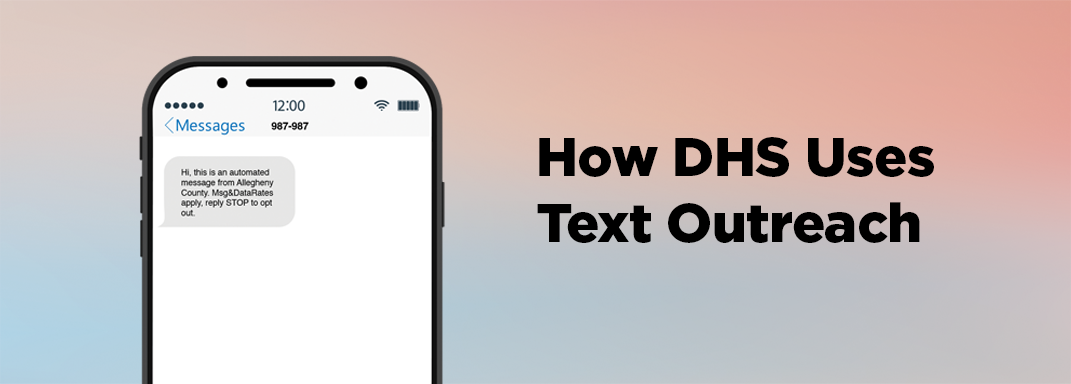
The Allegheny County Department of Human Services (DHS) engages clients and others who interact with DHS programs in a variety of ways: regular roundtables/cabinets (e.g., Children’s Cabinet); town halls and community forums; social media (e.g., Facebook and LinkedIn); and the Director’s Action Line (DAL). In 2018, DHS expanded its public engagement strategy to include SMS text messaging (texting), a tool that is convenient for recipients and allows DHS to scale up communication with clients and other Allegheny County residents.

How does DHS use text outreach? 

DHS uses text outreach in a variety of ways, including collecting feedback after a service touchpoint, increasing program engagement, recruiting for paid research opportunities, and providing timely alerts. Text messaging has allowed DHS to connect clients to resources at scale, and to solicit feedback from clients who would likely never otherwise have the time or opportunity to share their feedback.

What data is available?

The data brief provides more information about the communication strategy and descriptive analytics from 2018 to 2022. The interactive dashboard, which is updated daily, allows users to drill down to individual text campaigns to understand the purpose, the number of messages sent, and the demographics of people who were contacted.

Terms and Conditions

This service is used by the Allegheny County Department of Human Services to send you notifications about publicly funded services. You can cancel this service at any time. Just text “STOP” to 987987. After you send the message “STOP” to us, we will send you a reply message to confirm that you have been unsubscribed. After this, you will no longer receive messages from us. If you want to join again, just text “START” to 987987, and we will start sending messages to you again. If at any time you forget what keywords are supported, just text “HELP” to 987987 After you send the message “HELP” to us, we will respond with information about the program. Message frequency varies. Carriers are not liable for delayed or undelivered messages. As always, Message and Data Rates May Apply for any messages sent to you from us and to us from you. If you have any questions about your text plan or data plan, it is best to contact your wireless provider. For all questions about the services provided by this short code, you can contact us at DHS-Research@alleghenycounty.us

Please view our Privacy Policy here

Pittsburgh-Allegheny County is one of eight sites participating in the Community Choice Demonstration (CCD) – a large-scale, multi-site randomized controlled trial to test the efficacy of offering housing mobility-related services to families with children in the Housing Choice Voucher (HCV) program. The CCD builds on prior research showing that growing up in lower-poverty neighborhoods increases children’s academic achievement, long-term earnings as adults, and selected improved health outcomes for children and adults.

What is this report about? 

This Rapid Cycle Evaluation is the first report assessing the early implementation of the Demonstration and capturing the initial impact and costs of comprehensive mobility-related services (CMRS). The report provides preliminary findings on the locational outcomes for 596 HCV families with children who enrolled in the first 8 months of the 6-year Demonstration through March 2023. This is the first of a series of reports expected over the next eight years detailing progress of the Demonstration, which began in August of 2022 and ends in October 2028.

What are the takeaways?

An analysis of 12 months of data indicates that the Demonstration is having a statistically significant, positive impact on moves to low-poverty, high opportunity areas. Almost 24% of HCV families with children who received CMRS moved to an opportunity area, compared to 4% percent of HCV families in the control group. The offer of CMRS resulted in a nearly 20 percentage point increase in the share of families moving to an opportunity area within 12 months of study enrollment.

In May 2022, Allegheny County assembled a taskforce of leaders to reduce intimate partner violence (IPV) through improved coordination, information sharing, training, and implementation of interventions that target both those who use violence and those who are victims or survivors of it.

Historically, the County’s understanding of IPV has been based on national data, which, though useful, fails to capture local nuances that lend greater insight into specific community needs. The county published a report and dashboard to provide more local context to problems of IPV in Allegheny County by describing trends in demographics, human services involvement, and criminal histories among victims and perpetrators of intimate partner homicides (IPH). The report covers January 2017 through September 2022. The dashboard includes more recent information and is updated annually.

The analysis point to a disproportionate impact on individuals who are disadvantaged not only by their gender identity, but also by systemic racial and socioeconomic inequalities. Though IPV has traditionally been framed as an issue related to gender alone, a more intersectional understanding of risk and impact can better inform strategies for effective prevention and mitigation.

Key Findings from Report

  • There were 45 victims (43 incidents) of IPV and IPV-spillover homicides from January 2017 through September 2022.
  • The demographic trends among individuals involved in IPH are similar to those of overall homicides: victims and perpetrators are disproportionately Black, young (aged 25-34) and living in high-need areas. Black women represent the highest proportion of victims (37%, n=16), while Black men constitute the highest proportion of perpetrators (56%, n=23).
  • Unlike homicides at large, IPH victimization disproportionately impacts women: 63% of victims of IPH are women.  While IPH accounted for roughly 7% of all homicides from January 2017 through September 2022, they made up 30% of all homicides with female victims.
  • Both victims and perpetrators of IPH had high rates of involvement in human services.  74% of perpetrators had prior involvement with child welfare, publicly funded behavioral health, or homeless and housing systems.
  • 58% of victims had prior involvement with child welfare, publicly funded behavioral health, or homeless and housing systems.
  • Across all gender, race and role categories, about 53% of individuals involved in IPH – 47 of 88 – had criminal justice involvement at some point prior to the homicide incident: 63% of perpetrators (27 of 43) and 44% of victims (20 of 45). Among perpetrators with criminal justice involvement, both Black and White men had higher rates of involvement than either Black or White women.
  • Roughly 24% of all IPV perpetrators had indicators of IPV history in either the criminal courts or child protection system. This is likely an undercount of true IPV history, as data limitations, legal restrictions and underreporting make identification of non-fatal IPV in the data difficult. Among those with domestic violence related criminal cases, the majority occurred in the 18 months prior to the homicide incident.

Read more about the county’s IPV work here.


Current information

Allegheny County Department of Human Services (DHS) developed these publicly available, interactive dashboards in collaboration with resolve Crisis Services, the County’s provider for the 24-hour, 365-day mental health crisis service provided free to all Allegheny County residents.

These dashboards provide information about:

Crisis Calls: Overview of call volume to resolve Crisis Services through 988 Suicide & Crisis Lifeline and resolve’s 24-hour hotline 1-888-7-YOU-CAN (796-8226), consumer wait time to reach call clinician, abandoned call rate, and demographics of person-in-crisis who received call services. Aggregate call information is from April 2021 to present and is updated monthly. Demographic information is available from March 2023 to present and is updated monthly.

Mobile Team Dispatches: Overview of mobile team dispatch volume, consumer wait time, reasons for mobile team dispatch, dispatch rate by neighborhood, and demographics of people-in-crisis who received mobile interventions. Information is available from September 2023 to present. Data updated monthly.

Police Involvement: Percentages of calls and mobile team dispatches with police involvements. Information is available from September 2023 to present. Data updated monthly.

Access the report

From May through August 2024, Allegheny County Department of Human Services (DHS) engaged in a comprehensive needs assessment. The purpose of the assessment was to determine how DHS can best address the needs of individuals and families living in poverty and promote stability and economic security using Community Service Block Grant (CSBG) funds and other flexible funding across the agency. The assessment included collection and analysis of qualitative and quantitative data from community members and service providers.

Read the new report here.

What are the takeaways?

  • Despite a decrease in the overall poverty rate, there remain deep disparities in poverty by demographic groups. Black people, women with children and people with less than a high school diploma experience poverty at twice to three times Allegheny County’s rate.
  • Finding job opportunities was the number one challenge reported by survey respondents seeking employment. Additional barriers to employment include transportation and resumé/application preparation.
  • Workforce participant engagement for those receiving SNAP and TANF (i.e., those with low income, for whom relevant data are available) increased from 2021 to 2022, possibly explained by COVID-related participation extensions. The demand for job readiness/training programs among this population, particularly for SNAP recipients who are female and Black, is expected to increase further as SNAP work requirement waivers expire in 2025.

Allegheny County residents face significant challenges in accessing behavioral health services, an issue highlighted by recent studies and surveys. Notably, a Countywide survey revealed that 42.7% of respondents believe improving access to mental health care, particularly for young people, should be a priority. This finding is supported by research from the University of Pittsburgh, which documented long wait times for appointments and challenges in connecting with providers. These issues stem from a critical shortage of behavioral health professionals and are compounded by time-consuming provider search processes.

In response, the Allegheny County Department of Human Services (DHS), along with Community Care Behavioral Health (CCBH), the County’s behavioral health managed care organization, are pursuing a series of investments and initiatives aimed at addressing these barriers and increasing service availability.

To improve access and reduce wait times, DHS and CCBH are focusing on:

  • Creating visibility into appointment availability so clients and providers spend less time searching for services.
  • Supporting the behavioral health workforce through loan repayment and cohort-based training programs to increase the number of providers.
  • Investing in community-based mental health supports to offer additional options outside the traditional system.
  • Expanding access to proven treatments like medication-assisted therapy for opioid addiction, cognitive behavioral therapy and group therapy.
  • Augmenting clinical decision-making to ensure those who need help most get it quickly
Current information

The Allegheny County Department of Human Services (DHS) funds programs to assist young adults who are transitioning out of the child welfare system (also known as transition-aged youth) to secure employment, education, housing, behavioral health services, financial advice and more. Despite these service offerings, transition-aged youth have higher rates of homelessness, substance use, mental health challenges and incarceration, as well as lower rates of high school graduation compared with people who were not involved with the child welfare system. While targeted services are important, some human service needs result from poverty, which can be mitigated by providing direct financial assistance.

What is this report about?

In the summer of 2023, DHS launched a direct cash support program called Cash Assistance for Allegheny Young Adults (CAAYA), which provided a one-time payment of $4,000 to young adults, ages 18 through 22, with a history in the child welfare system, who were experiencing homelessness or were young parents who had an open case with Allegheny County’s child welfare office. In this report, we present a mixed-methods approach to evaluating the impact of CAAYA, including longitudinal surveying, a quasi-experimental analysis of administrative data in the Allegheny County Data Warehouse, and semi-structured interviews with cash recipients.

What are the takeaways?

  • CAAYA recipients demonstrated significant financial need. At the launch of the program, only 35% reported being currently employed and only 29% reported being in school either full-time or part-time. Those who had some form of formal employment in the 12 months before the program had mean annual earnings of $10,174. Twenty-eight percent had one or more children.
  • CAAYA recipients also lacked financial support within their community. Two-thirds of recipients reported not knowing anyone who would lend them $500 in a time of crisis.
  • Overall, the program encouraged about 100 individuals to open a bank account. Seventy-five percent (n = 774) of recipients chose to receive the money via bank account transfer and 25% via a virtual gift card.
  • Recipients used the cash assistance quickly. On average, $2,769 of the $4,000 was spent within the first month.
  • Car-related expenses ranked as the number one item for planned expenditures, and there was a 41% relative increase in car ownership three months after receiving the money.
  • The program improved self-reported well-being after receiving financial assistance, but the effects faded in the subsequent months.
  • CAAYA recipients increased their use of mental health outpatient therapy by 7% compared to a control group of individuals who were narrowly ineligible for the program. There was no change in utilization of crisis and inpatient services. In contrast to self-reported well-being, the program’s impact on usage of outpatient mental health services persisted for at least eight months after receiving funds.

How is this report being used?

As a result of this program, we are exploring additional opportunities to leverage cash assistance with this population to increase engagement in holistic supports and services. We are also considering longer-term programs with more frequent, smaller payments to targeted populations.  For future programs, we hope to receive state waivers for the impact of cash assistance on public benefits, especially if a program is designed to include ongoing payments.

For other local governments or providers who are considering cash assistance programs, we hope this report serves as a resource for program design and evaluation. Local governments should note that the success of the CAAYA program would not have been possible without our partner organizations. Trust in government significantly impacts the accessibility of services, particularly for marginalized communities. When first hearing about the cash assistance, many individuals who were eligible to receive the money thought that it was a scam. This skepticism was eased by having multiple trusted intermediaries ensure that it was a real program and that they should apply.