
As required by the US Department of Housing and Urban Development (HUD), Allegheny County conducts an annual Point-in-Time count of individuals experiencing homelessness on a single night. The count identifies individuals who are sheltered (residing in emergency shelters), unsheltered (residing in places not meant for human habitation), or participating in a short-term housing program (bridge and safe haven).
2026: A New Approach
In 2026, Allegheny County launched “Community Counts,” a reimagining of this annual effort that marked the start of a new, volunteer-driven approach to the unsheltered estimate. The new methodology emphasizes geographic coverage using statistically valid sampling and can be replicated to allow for more accurate year-over-year trends.
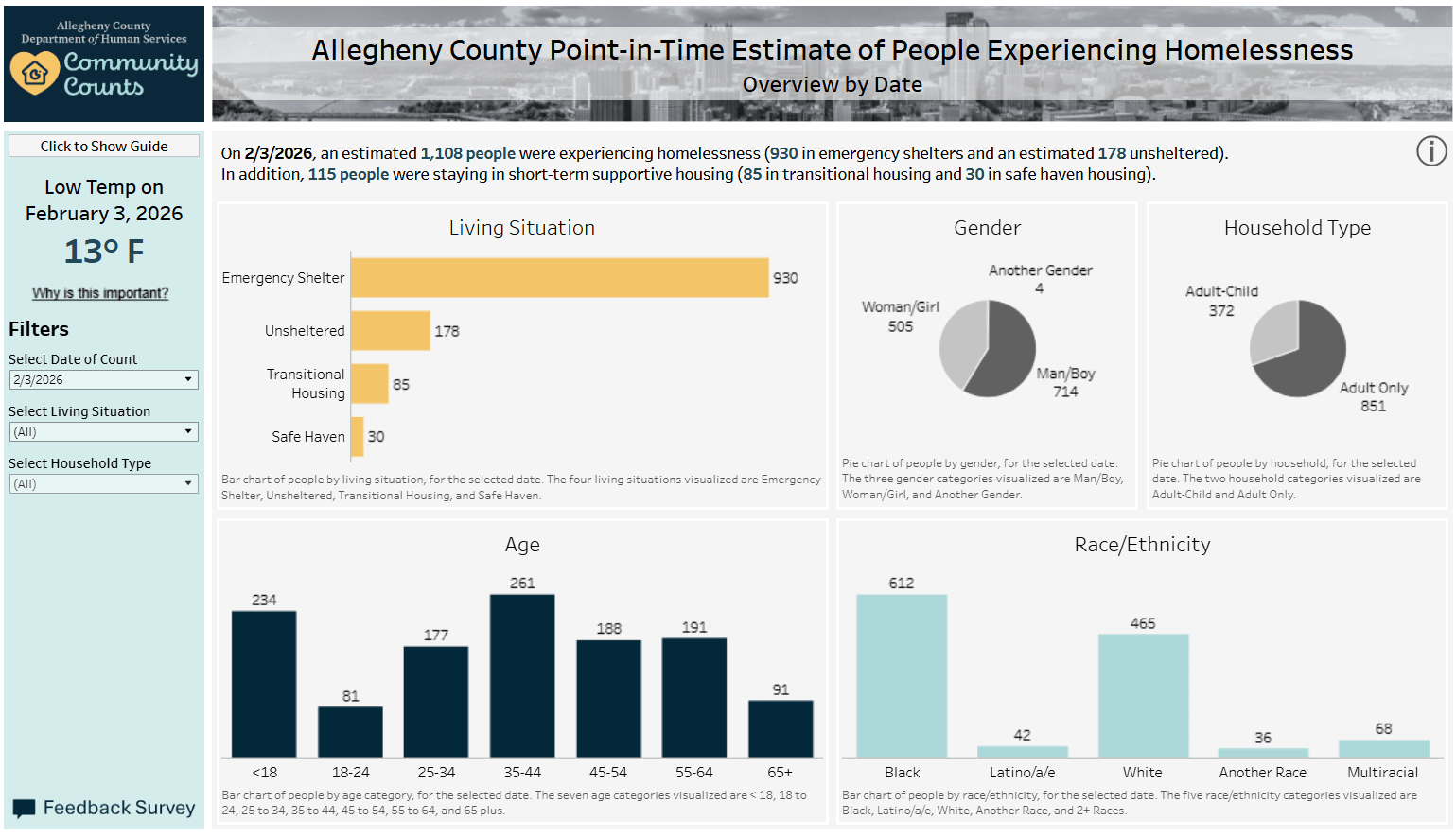
Due to a major snowstorm at the end of January 2026, Community Counts was delayed by one week and conducted from the night of Tuesday, February 3rd into the morning of Wednesday, February 4th. The overnight low temperature was 13°F and the region remained snow-covered. Despite the weather, about 270 volunteers joined the effort.
Key Takeaways
- Most (84%) of Allegheny County’s total estimated homeless population on the night of the count were in shelter as opposed to staying outside. Although the County had sufficient capacity to serve more people in shelter, some people remained outside despite the frigid temperatures and snow. Individuals may stay outside for many reasons, including lack of alignment between available shelter and individual needs (e.g., location and accessibility), concerns related to safety or prior negative experiences in congregate shelter settings, behavioral health challenges, or barriers related to partners, pets and/or personal belongings. Street outreach teams continue to work with these individuals to build trust over time, understand barriers to coming indoors, and, when they are ready, provide connections to services.
- This year’s estimated unsheltered population of 178 people (all adults) is a new baseline. Using the same methodology next year will allow us to begin to compare year-over-year trends.
- The unsheltered population appears to have been concentrated in the same general regions within the County as last year (South Side, South Hilltop, Homewood, the Central Business District and North Side), but in some cases, shifted within those areas.
- Abandoned houses/buildings and tents/temporary shelters were the most common unsheltered sleeping locations. Twenty percent of those counted as unsheltered had an unknown sleeping location as they were not yet bedded down when surveyors observed or attempted to interview them.
- We have more to learn about where people are unsheltered. Surveyors identified a small number of people experiencing unsheltered homelessness outside of known areas, even with a simple random sample. The research team is exploring ways to stratify next year’s random sample to reflect that some areas and types of places are less likely to have people sleeping unsheltered.
- Volunteers had positive experiences and good ideas for next year. In a feedback survey, 90% of respondents said they would volunteer again next year and were likely to recommend the event to a friend (average score eight out of 10). For next year’s Community Counts, we plan to enhance training, improve survey area navigation, provide additional supplies to hand out, and add at least one hub so that the number of teams is capped at 15 per hub.
Dashboard
For the best experience, we encourage exploring the Community Counts Dashboard on its full site.
Additional Resources
The annual count is one way to understand trends in homelessness in the County. ACDHS maintains two other dashboards that provide additional insights:
Previous Reports
If you encounter any accessibility issues, have difficulty accessing any digital content, or require information presented on a website in an alternate format, please contact the ADA Coordinator or submit a concern through the Accessibility on Allegheny County-owned Websites form.
Questions or Feedback?
We welcome your questions and suggestions. To share feedback, you can reach us at DHSResearch@alleghenycounty.us. If you’d like to stay informed, consider signing up for our newsletter. To learn how to use DHS data in your research, please visit our Requesting Data page. Thank you for your time and interest. Your engagement helps shape and improve how we share data that matters.