Allegheny County Continuum of Care (CoC) is the network of services and stakeholders engaged in making homelessness rare, brief and non-recurring. Allegheny County CoC includes all of Allegheny County, the City of Pittsburgh, the City of McKeesport and the Municipality of Penn Hills.
How the Continuum of Care Works
Homeless Advisory Board
The Homeless Advisory Board (HAB) is the working board of the Allegheny County CoC. Utilizing the expertise of its members, the HAB is responsible for planning, coordinating and operating a system within Allegheny County that meets the needs of individuals and families experiencing homelessness. Members of the HAB represent individuals who are homeless/formerly homeless, service agencies, planning and advocacy bodies, and funders.
HAB Committees
Five standing committees support the work of the HAB to supply advisory guidance and carry out its responsibilities. Ad hoc committees carry out special initiatives that focused efforts can best accomplish. Each HAB committee has two co-chairs, one representing the CoC-at-large and one HAB member. Co-chairs are responsible for setting the direction and agenda for the committee in accordance with HAB priorities and ensuring the correct membership mix is available for committee work.
The Role of the Allegheny County Department of Human Services
Delegated by the HAB, the Allegheny County Department of Human Services (DHS) serves as the Infrastructure Organization and manages day-to-day administrative and operational responsibilities. In this role, DHS receives CoC funding and administers it to service providers. DHS also provides programmatic and fiscal oversight; operates and maintains both the Coordinated Entry System (through Allegheny Link) and the Homelessness Management Information System; monitors performance; provides data, research and reports; and staffs HAB meetings and initiatives.
Governance Charter
The Allegheny County CoC Governance Charter (PDF, 637KB) summarizes the responsibilities and authorities for operation and governance of the Allegheny County CoC under the Homeless Emergency Assistance and Rapid Transition to Housing Act (HEARTH Act).
Membership
Membership in the Allegheny County CoC is open to any individual interested in contributing to and productively shaping the delivery of homeless services. Continuum of Care members must annually attend at least one recognized meeting of the CoC (which includes CoC meetings or HAB committee meetings) and provide basic contact information.
Any member of the CoC can serve on a HAB committee. Every HAB committee has one co-chair who is a CoC member.
Each November, the HAB invites CoC members to join the HAB. Interested individuals may complete a nomination form for themselves or another person. The HAB Executive Committee first screens the nominations, and then the full HAB votes on the slate of proposed members at the subsequent January meeting.
To become a CoC member, please contact Hilary Scherer at 412-350-4938
Community Strategic Planning Process
In late 2024, DHS and the HAB launched a planning process to develop a Strategic Improvement Plan to guide and strengthen the community’s homelessness response system. Between October 2024 and November 2025, more than 200 individuals contributed to this planning process through focus groups, interviews, site visits, meetings with many different organizations, input sessions, frontline listening sessions, committee and subcommittee meetings, and a survey.
These perspectives, combined with quantitative system data and national best practices, are shaping the priorities and strategies for the plan. The resulting five-year Strategic Improvement Plan (2026-2030) aims to prevent and end homelessness by (a) building upon current strengths within Allegheny County’s homelessness response system and (b) identifying and prioritizing the most important improvement opportunities.
We welcome your questions and suggestions. To share feedback, you can reach us at DHSResearch@alleghenycounty.us. If you’d like to stay informed, consider signing up for our newsletter. To learn how to use DHS data in your research, please visit our Requesting Data page. Thank you for your time and interest. Your engagement helps shape and improve how we share data that matters.
The Street Stabilization Team (SST), a new intervention launched by the Allegheny County Department of Human Services (ACDHS) in July 2026, is designed to address the difficulty faced by healthcare systems and publicly funded programs supporting people who demonstrate profound disability and/or high vulnerability and who are chronically disengaged from clinic-based care due to the severity of psychiatric symptoms and/or substance use disorder (SUD). The intervention aims to serve 20–30 of the County’s most vulnerable unhoused residents.
A shared mission guides the work of SST staff from ACDHS, University of Pittsburgh Medical Center (UPMC) and Allegheny Health Network (AHN):
To improve complex care coordination for individuals with multi-system needs, frequent crisis encounters and increased risk of adverse outcomes and create an interconnected, trauma informed response, in which individuals with complex needs receive timely and comprehensive care, minimizing crisis events and ensuring equitable access to essential services.
About SST
What services does SST offer?
Participants in the SST program receive a comprehensive blend of behavioral health, medical and social supports delivered by a coordinated multidisciplinary team. The team conducts mobile diagnostic assessments and facilitates communication with and access to medical and behavioral health facilities and providers. Staff also offer health education and medication management and ensures coordinated risk assessment and crisis response.
Service Eligibility
In order to be eligible for the SST program, a person must:
Be an Allegheny County resident, age 18 and older.
Be currently unhoused/experiencing street homelessness.
Demonstrate severe psychiatric symptoms related to mental health or substance use issues.
Be unwilling or unable to engage in traditional services due to severity of symptoms.
Be assessed as highly vulnerable based on a street assessment and/or risk model.
How do SST referrals work?
Because SST-eligible clients are managing severe and unmet behavioral health needs and are routinely disengaged from human services programs, no single referral process can be expected to identify all eligible individuals; rather, SST referrals are made through two channels: provider referrals and data-driven referrals.
Provider Referrals
Provider referrals are a critical entry point into the SST program and come from the following sources:
City of Pittsburgh Office of Community Health and Safety providers
resolve Crisis Center
Street Medicine teams
Street Outreach teams
Alternative Response Team (A-Team)
Complex case meetings for incarcerated individuals
Data-Driven Referrals
Data-driven referrals use a data-driven model to create a referral list of 100 eligible people each month. Because there is significant overlap between the data-driven referrals each month, we expect the data-driven process to refer a total of 250-300 distinct people over a one-year period. We also expect that 60%-70% of provider referrals will appear in the data-driven referral list.
How does SST case conferencing work?
After an individual is identified through either referral pathway, the SST enrollment process begins with a case conference in which the team reviews available information to determine whether the person’s needs align with the program’s eligibility criteria. This review process is augmented with summaries provided utilizing a Large Language Model (LLM) based on data from the Homeless Management Information Systems (HMIS) and a number of Electronic Health Record (EHR) systems.
Data-Driven Model Implementation
The data-driven referral list is created using a composite of four data-driven models and filtered based on the set of eligibility criteria previously described. The composite is a deterministic function of four data-driven models that predict binary outcomes (0,1)
This table provides details of the models, providing description, base rate and reason for each.
Predictive Outcome
Description
Base Rate in County
Reason for Inclusion
Number (n)
Percent (%)
Involuntary hospitalization (302) within one year
A binary outcome (0,1) equal to one if there is an upheld 302 petition for an individual in the year following the referral date
2,509
0.47%
Legally, 302s in Allegheny County are designed to allow for intervention when individuals managing mental health crises present a danger to themselves or others. For SST referrals, a 302 is used as a proxy for individuals for whom step-down behavioral health services are not working.
Allegheny County Jail (ACJ) booking within one year
A binary outcome (0,1) equal to one if an individual is booked in ACJ in the year following the referral date
5,870
1.10%
The cohort for whom SST was designed has a materially higher rate of interaction with first responders than the general population. For SST referrals, ACJ booking is used as a proxy for when an individual has a negative interaction with the criminal-legal system.
Indication of being unhoused within one year
A binary outcome (0,1) equal to one if a person checks into a County shelter, continues to stay in a shelter for at least 60 days or interacts with a street outreach team in the year after the referral date
2,515
0.47%
SST is designed to serve people who are unhoused. For SST referrals, encounters with a street outreach team or staying in a shelter is a proxy for a person experiencing homelessness in the future.
Fatal overdose within one year
A binary outcome (0,1) equal to one if there is a Medical Examiner determination of death by overdose on a date within one year after the referral date
338
0.06%
SST serves people who demonstrate profound disability and/or high vulnerability and are chronically disengaged from clinic-based care due of the severity of psychiatric symptoms and/or substance use disorder (SUD). For SST referrals, a Medical Examiner determination of fatal overdose is used to identify individuals experiencing SUD.
Given the rarity of this outcome, we are exploring opportunities to replace or augment it as data become available.
SST staff and clients are never shown the raw composite rating or component-model outputs. An individual excluded from the data-driven referral list for any reason is still eligible for a provider referral.
Data-Driven Referral Performance
The composite is used as a proxy for co-occurring severe psychiatric symptoms, chemical dependency, and acute risk of morbidity and mortality. The referral list includes the subset of people who have the highest composite ratings based on the model assessments after filtering for eligibility.
Considering outcomes for the top 50, 100 and 200 people on the list (after filtering for eligibility) helps describe the severity of the situation of the people who are referred. We expect more than 90% of people on the referral list to experience one of the four predicted outcomes in the year after their referral date. In most cases, they will experience more than one.
This table shows the elevated rates at which the predicted outcomes occur among individuals assessed at highest risk by the data-driven model. For each of the predicted outcomes, it compares Precision (the fraction of cases that are a true positive) to the base rates at which outcomes are observed in the training data. It makes this comparison for each of the four predictive outcomes.
Metric
ACJ
Overdose
302
Shelter
One or More
Precision (Top 50)
64.0%
4.0%
34.0%
76.0%
92.0%
Precision (Top 100)
63.0%
3.0%
24.0%
69.0%
91.0%
Precision (Top 200)
54.5%
1.5%
17.0%
61.5%
81.0%
Base Rate Among Unhoused, Eligible Residents
16.4%
0.5%
4.1%
40.8%
48.4%
Data-Driven Referral Fairness
In addition to performance, we used standard measures to assess the fairness of the data-driven model referrals. The key metric, the sensitivity ratio, is the ratio of recall among demographic subgroups. Recall is the fraction of all cases among the cohort referred by the model in which one or more outcomes occur. We used the Sensitivity Ratio to judge whether the model assigned output fairly based on subgroup demographic. As no process will have a Sensitivity Ratio of exactly 1.0, we consider models with Sensitivity Ratios between 0.7 and 1.3 as performing well according to this fairness diagnostic.
To make this comparison, we ran the referral process once per month on historical data for each month of 2024. The model returned 1,200 referrals, representing 284 unique individuals.
Race
With regards to race, the composite showed slightly higher precision and slightly lower recall for non-White individuals compared to a reference group of White individuals.
This table shows the fairness metrics for non-White and White individuals who would have been referred using the composite and heuristic methodologies. The table captures the precision and recall by group, then uses the recall to calculate sensitivity ratio.
Metric
Referral Method
Precision (non-White)
Precision (White)
Recall (non-White)
Recall (White)
Sensitivity Ratio
One or More Outcomes
Composite (n=1,200)
91.5%
88.3%
8.1%
9.4%
0.86
Gender
When comparing gender, we used binary male and female labels because gender data are tracked as a binary in the Allegheny County data warehouse. The composite showed slightly higher precision and slightly lower recall among females than among males.
This table shows the fairness metrics for female and male individuals who would have been referred using the composite and heuristic methodologies. The table captures the precision and recall by group, then uses the recall to calculate sensitivity ratio.
Metric
Referral Method
Precision (Female)
Precision (Male)
Recall (Female)
Recall (Male)
Sensitivity Ratio
One or More Outcomes
Composite (n=1,200)
93.8%
88.1%
8.5%
8.8%
0.97
LLM Summary Example
The summaries act as a starting point for case conceptualization. They provide plain text descriptions of a client’s interactions with County services and institutions. Below is an example report that includes synthetic data on housing services and evictions as well as behavioral health services and diagnoses.
Client Report
Client Information
ID:
0000000
FNAME:
Fname
LNAME:
Lname
DOB:
YYYY-MM-DD
Admin Data Summary
Housing Services & Evictions
The client’s first housing-related event was an emergency
shelter stay in January 2019. In the past year, the client
received Transitional Housing placement, Rapid Rehousing
assistance and Permanent Supportive Housing placement,
totaling three housing interventions. In the last three
months, the client remained in a Permanent Supportive
Housing placement, specifically since .
The client is currently residing in Permanent Supportive
Housing.
Behavioral Health Services & Diagnoses
The client’s first behavioral health event was receiving
SUD non-opioid or OUD
treatment through HealthChoices in 2003.
In the past year, the client had four interactions with
behavioral health services, including:
3 mental health episodes in an emergency room
1 mental health episode with an inpatient visit
1 record of receiving SUD
non-opioid or OUD treatment through
HealthChoices
In the last three months, the client had two behavioral
health events: one emergency room mental health episode
and one instance of receiving SUD
treatment through HealthChoices, which has been ongoing
since .
There are no current ongoing behavioral health events
beyond those noted in the past 3 months.
Recent Events (Past 90 Days)
Description
Most Recent Event
Event Count
Mental health episode in an emergency room
1
Permanent Supportive Housing placement
1
LLM Summary Performance
The goal of the LLM is to format structured data to be more legible and easily accessible to a member of the care team. It should not make choices about what information to include or not include. We used an LLM-as-judge approach with a private GPT 4.1 deployment in our cloud tenant to evaluate performance on a sample of 5,000 summaries. Additionally, we used human review to assess the quality of the LLM judge.
We employed the following LLM-as-judge metrics:
Recommendations: The fraction of summaries flagged by a GPT 4.1 evaluator to contain a recommendation or call to action for the reader
Information Modified: The fraction of summaries flagged by a GPT 4.1 evaluator to contain event descriptions that are rewritten in a way that changes the meaning of an event from the input artifact
Information Excluded: The fraction of summaries flagged by a GPT 4.1 evaluator that omitted an event in the input artifact
The final metric is event miscounts, the fraction of summaries featuring event counts that do not correspond to the count in the input artifact. Event miscounts are computed using regex.
This table shows the metrics used to evaluate language model candidates for use in the summary task. It compares Qwen3-4B-Instruct, Qwen2.5-32B and Llama3.3-70B.
Metric
Qwen3-4B-Instruct
Qwen2.5-32B
Llama3.3-70B
LLM-as-judge
—
—
—
Recommendations
0.00%
0.00%
0.00%
Information Modified
1.12%
2.80%
3.44%
Information Excluded
0.04%
0.12%
0.12%
Event Miscounts
0.00%
0.00%
0.00%
n clients
777
397
397
n summaries
5,000
2,500
2,500
Community Input in SST
Beginning in late 2023, ACDHS gathered input from stakeholders and practitioners in community mental health and homelessness services to inform and refine the development of the SST design.
We welcome your questions and suggestions. To share feedback, you can reach us at DHSResearch@alleghenycounty.us. If you’d like to stay informed, consider signing up for our newsletter. To learn how to use DHS data in your research, please visit our Requesting Data page. Thank you for your time and interest. Your engagement helps shape and improve how we share data that matters.
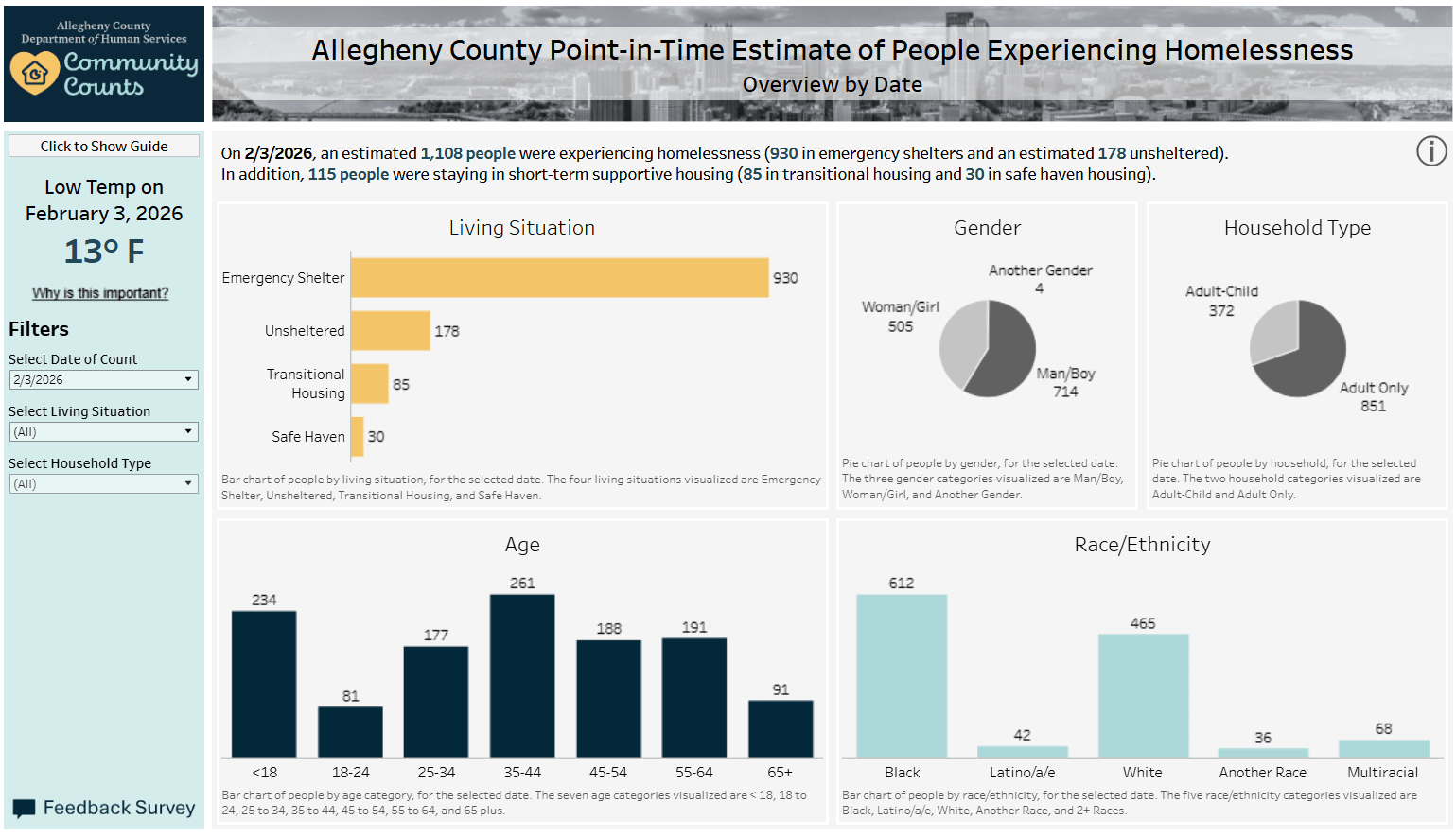
As required by the US Department of Housing and Urban Development (HUD), Allegheny County conducts an annual Point-in-Time count of individuals experiencing homelessness on a single night. The count identifies individuals who are sheltered (residing in emergency shelters), unsheltered (residing in places not meant for human habitation), or participating in a short-term housing program (bridge and safe haven).
2026: A New Approach
In 2026, Allegheny County launched “Community Counts,” a reimagining of this annual effort that marked the start of a new, volunteer-driven approach to the unsheltered estimate. The new methodology emphasizes geographic coverage using statistically valid sampling and can be replicated to allow for more accurate year-over-year trends.
Due to a major snowstorm at the end of January 2026, Community Counts was delayed by one week and conducted from the night of Tuesday, February 3rd into the morning of Wednesday, February 4th. The overnight low temperature was 13°F and the region remained snow-covered. Despite the weather, about 270 volunteers joined the effort.
Key Takeaways
Most (84%) of Allegheny County’s total estimated homeless population on the night of the count were in shelter as opposed to staying outside. Although the County had sufficient capacity to serve more people in shelter, some people remained outside despite the frigid temperatures and snow. Individuals may stay outside for many reasons, including lack of alignment between available shelter and individual needs (e.g., location and accessibility), concerns related to safety or prior negative experiences in congregate shelter settings, behavioral health challenges, or barriers related to partners, pets and/or personal belongings. Street outreach teams continue to work with these individuals to build trust over time, understand barriers to coming indoors, and, when they are ready, provide connections to services.
This year’s estimated unsheltered population of 178 people (all adults) is a new baseline. Using the same methodology next year will allow us to begin to compare year-over-year trends.
The unsheltered population appears to have been concentrated in the same general regions within the County as last year (South Side, South Hilltop, Homewood, the Central Business District and North Side), but in some cases, shifted within those areas.
Abandoned houses/buildings and tents/temporary shelters were the most common unsheltered sleeping locations. Twenty percent of those counted as unsheltered had an unknown sleeping location as they were not yet bedded down when surveyors observed or attempted to interview them.
We have more to learn about where people are unsheltered. Surveyors identified a small number of people experiencing unsheltered homelessness outside of known areas, even with a simple random sample. The research team is exploring ways to stratify next year’s random sample to reflect that some areas and types of places are less likely to have people sleeping unsheltered.
Volunteers had positive experiences and good ideas for next year. In a feedback survey, 90% of respondents said they would volunteer again next year and were likely to recommend the event to a friend (average score eight out of 10). For next year’s Community Counts, we plan to enhance training, improve survey area navigation, provide additional supplies to hand out, and add at least one hub so that the number of teams is capped at 15 per hub.
We welcome your questions and suggestions. To share feedback, you can reach us at DHSResearch@alleghenycounty.us. If you’d like to stay informed, consider signing up for our newsletter. To learn how to use DHS data in your research, please visit our Requesting Data page. Thank you for your time and interest. Your engagement helps shape and improve how we share data that matters.
Unsheltered homelessness refers to a situation in which an individual is living in a place not meant for human habitation, such as on the street, in an encampment, or in an abandoned building. Experiences of unsheltered homelessness vary; i.e., episodes may be intermittent or continuous, short or long. Some individuals move back-and-forth between unsheltered and sheltered situations.
We have created three public-facing dashboards that include information about unsheltered homelessness in Allegheny County. Each dashboard uses a different data source and thus presents a distinct way of thinking about and understanding this issue in our region.
The unsheltered tab of this dashboard displays weekly counts of street outreach clients with recent stays outside, from 2022 to present.
This dashboard uses street outreach program data from the Homeless Management Information System (HMIS).
Use this dashboard to see trends over time (including seasonal changes) in the number of street outreach clients whose most recent living situation was an unsheltered one.
This dashboard cannot tell you the number of people unsheltered on any given night and it only captures information on clients who are enrolled in a street outreach program that uses HMIS. Some unsheltered individuals do not want to engage with outreach staff; others are enrolled in programs that do not use HMIS. Additionally, while the data refresh every week, the dashboard considers recorded living situations up to 30 days prior and cannot provide an “as of today” snapshot.
This dashboard shows visible tent encampments in Downtown Pittsburgh and riverfront trails, updated weekly, from 2023 to present.
This dashboard uses data from an observational survey regularly conducted by ACDHS staff who typically cover the route on bicycle.
Use this dashboard to see trends over time in the number of visible tents and makeshift structures in Downtown Pittsburgh and riverfront trails.
This dashboard does not calculate the actual number of people using a tent or structure. One tent/structure may house one or more people. It may also be vacant, shared, borrowed or used for storage. The data collection route is limited to specific parts of Downtown Pittsburgh and riverfront trails and does not cover all of Allegheny County. It does not include data on other encampments that may be hidden from public view but known to ACDHS or other outreach providers.
The unsheltered estimate uses survey data collected on or just after the night of the count. In 2026, we launched “Community Counts” to mark the reimagining of this annual effort toward an approach that will allow for more accurate year-over-year trends.
Use this dashboard to see an estimate of the number of people sleeping unsheltered on a single night and how that compares to the number of people staying in shelter or other short-term housing programs. Using the available filters, you can also see basic demographic information (age, race/ethnicity, gender) for the estimated unsheltered population.
These data are limited to one night each year (always in winter). The methodology for the unsheltered count has changed over time, which has made it difficult to accurately compare year-over-year trends. But the newly implemented methodology, which is standardized and replicable, now allows for such comparisons beginning with the 2026 count.
Questions or Feedback?
We welcome your questions and suggestions. To share feedback, email us at DHSResearch@alleghenycounty.us. If you’d like to stay informed, consider signing up for our newsletter. To learn how to use ACDHS data in your research, please visit our Requesting Data page. Thank you for your time and interest. Your engagement helps shape and improve how we share data that matters.
In the last eight years, the number of Americans experiencing homelessness in the United States has increased by 40%, even as the supply of subsidized housing has doubled. Research shows that housing programs effectively support housing stability. However, system-level outcomes depend on whether housing reaches people likely to exit shelter quickly or those likely to experience longer-term housing instability. Systems that prioritize people with shorter expected stays reduce homelessness less than when they prioritize people facing longer-term instability. Using administrative data from Allegheny County, this policy brief and working paper examine how often housing does not reach those with the greatest need, identify and characterize those who do not receive services, and outline how to recognize these individuals before their homelessness becomes long-term.
Key Results
Using administrative data from Allegheny County, we have developed a predictive model that identifies—at the time of shelter entry—individuals likely to experience an extended shelter stay.
Most shelter residents exit shelter on their own within weeks after starting their shelter stay.
Among the highest-risk individuals flagged by the model, over 40% go on to experience extended homelessness—over three times the baseline rate.
Allocating housing to individuals or families at the highest risk of prolonged shelter stays would prevent approximately 2.4 times more shelter days per unit than allocating to the average shelter resident.
Making housing allocations based on the predictive model rather than current federal prioritization criteria would prevent 120% more shelter days.
Shifting from retrospective to prospective targeting could substantially reduce overall homelessness without expanding the subsidized housing supply.
Why This Matters and What’s Next
Homelessness remains difficult to solve. These data highlight a core challenge: most individuals resolve occurrences of homelessness quickly, while housing supports take time to deploy.
Without thoughtful allocation, resources do not reach people with the greatest need. Allegheny County continues to develop approaches that prioritize resources for individuals at highest-risk. This principle already guides ACDHS programs such as 500 in 500 and the Allegheny Housing Assessment, which have successfully prioritized individuals for housing in times of acute need.
Questions or Feedback?
We welcome your questions and suggestions. To share feedback, email us at DHSResearch@alleghenycounty.us. If you’d like to stay informed, consider signing up for our newsletter. To learn how to use ACDHS data in your research, please visit our Requesting Data page. Thank you for your time and interest. Your engagement helps shape and improve how we share data that matters.
The Intimate Partner Violence Reform Initiative was created in May 2022 to coordinate policy and system-level work across agencies in Allegheny County to improve a complex and fragmented system for both survivors of intimate partner violence (IPV) and those who use violence.
Stakeholders from local and federal criminal justice systems, victim service organizations, community groups, healthcare and human services are working to improve the ways in which people can access help, how our systems work together and share information, and how we can prevent the most serious harm. This includes innovations in adapting and implementing intimate partner violence focused deterrence strategies in Allegheny County.
Across the U.S., cities are facing increasing numbers of people experiencing homelessness. Meanwhile, an inadequate supply of deeply affordable housing has made it nearly impossible for individuals and families to move out of the shelter system.
Allegheny County’s 500 in 500 initiative responded to this needs gap with urgency, coordination, flexibility and creative problem-solving. County and City government, housing authorities, nonprofit organizations, foundations, developers and advocacy groups came together to make existing units or building conversions available for people living in shelters. The initiative moved hundreds of people from shelter to permanent housing, freed up shelter space for individuals and families in crisis and reduced strain across the homelessness response system.
Read the report below to learn how the initiative took shape, hear perspectives from those closest to the work and explore results as of day 500.
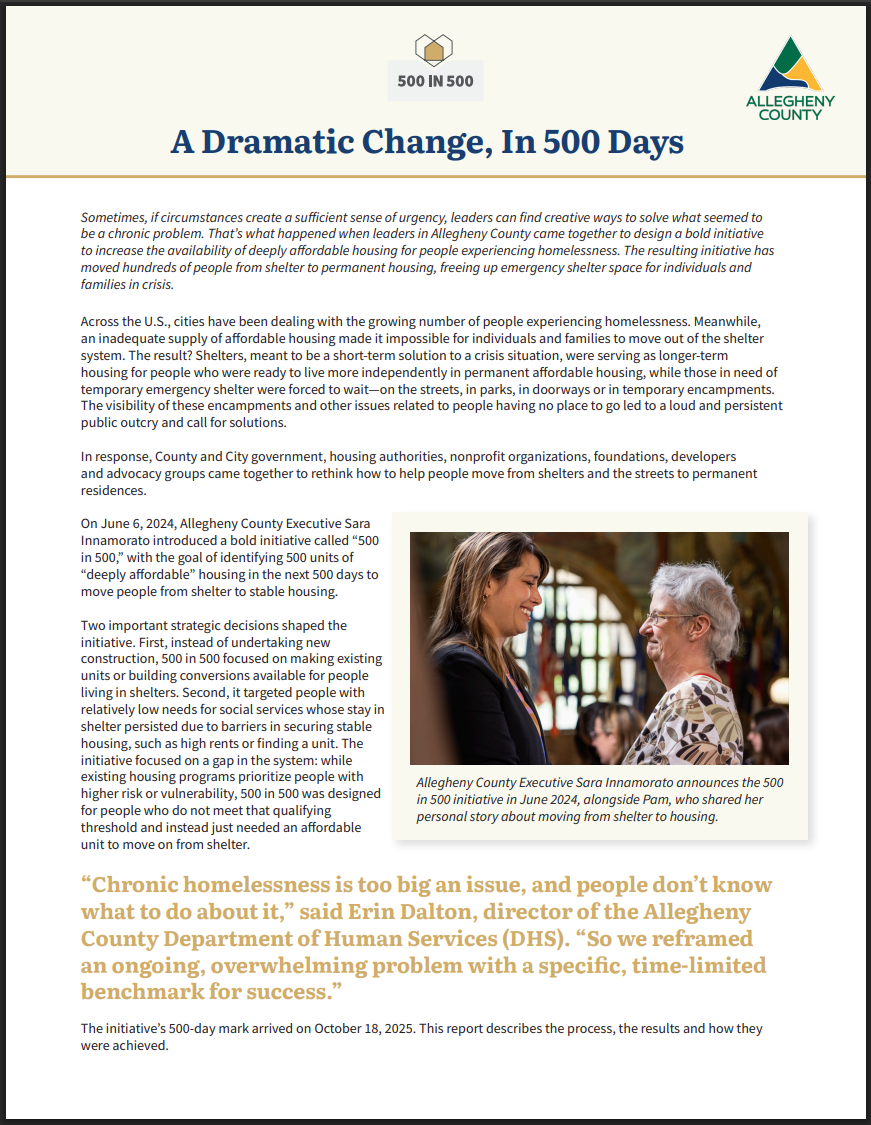
A Dramatic Change, In 500 Days
Sometimes, if circumstances create a sufficient sense of urgency, leaders can find creative ways to solve what seemed to be a chronic problem. That’s what happened when leaders in Allegheny County came together to design a bold initiative to increase the availability of deeply affordable housing for people experiencing homelessness. The resulting initiative has moved hundreds of people from shelter to permanent housing, freeing up emergency shelter space for individuals and families in crisis.
Across the U.S., cities have been dealing with the growing number of people experiencing homelessness. Meanwhile, an inadequate supply of affordable housing made it impossible for individuals and families to move out of the shelter system. The result? Shelters, meant to be a short-term solution to a crisis situation, were serving as longer-term housing for people who were ready to live more independently in permanent affordable housing, while those in need of temporary emergency shelter were forced to wait—on the streets, in parks, in doorways or in temporary encampments. The visibility of these encampments and other issues related to people having no place to go led to a loud and persistent public outcry and call for solutions.
In response, County and City government, housing authorities, nonprofit organizations, foundations, developers and advocacy groups came together to rethink how to help people move from shelters and the streets to permanent residences.
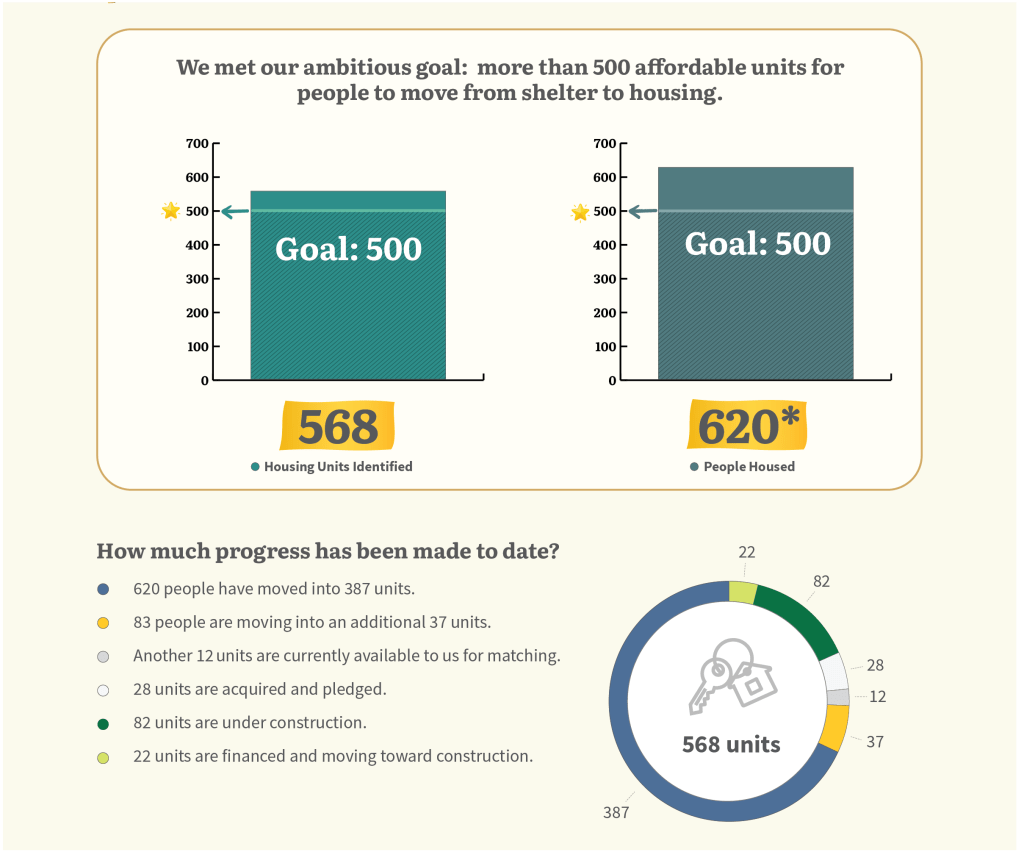
On June 6, 2024, Allegheny County Executive Sara Innamorato introduced a bold initiative called “500 in 500,” with the goal of identifying 500 units of “deeply affordable” housing in the next 500 days to move people from shelter to stable housing.
Allegheny County Executive Sara Innamorato announces the 500 in 500 initiative in June 2024, alongside Pam, who shared her personal story about moving from shelter to housing.
Two important strategic decisions shaped the initiative. First, instead of undertaking new construction, 500 in 500 focused on making existing units or building conversions available for people living in shelters. Second, it targeted people with relatively low needs for social services whose stay in shelter persisted due to barriers in securing stable housing, such as high rents or finding a unit. The initiative focused on a gap in the system: while existing housing programs prioritize people with higher risk or vulnerability, 500 in 500 was designed for people who do not meet that qualifying threshold and instead just needed an affordable unit to move on from shelter.
“Chronic homelessness is too big an issue, and people don’t know what to do about it,” said Erin Dalton, director of the Allegheny County Department of Human Services (DHS). “So we reframed an ongoing, overwhelming problem with a specific, time-limited benchmark for success.”
The initiative’s 500-day mark arrived on October 18, 2025. This report describes the process, the results and how they were achieved.
Formulating a strategy
Affordable housing was a high priority for Innamorato—and an issue she understood well. Having experienced housing instability as a teen, Innamorato prioritized housing policy issues long before becoming County Executive. She served on the board of the Allegheny County Housing Authority (ACHA), and as a State Representative introduced the landmark Whole Home Repairs Act in the state legislature. When elected to lead Allegheny County, Innamorato made it clear that affordable, accessible housing for everyone in Allegheny County was one of her signature priorities.
For Dalton, who managed DHS’s analytics work before becoming its director, everything starts with data. The most obvious data in this case were rising numbers of people on the streets and longer stays in shelters. But along with increasing need, Dalton also saw hopeful data on the supply side, in the form of the thousands of empty apartment units and subsidized housing vouchers available through the City and County housing authorities.
Debbie, a former teacher, in her new apartment with her dog Baxter. Debbie moved into her apartment in November 2024.
Public housing and voucher subsidies are in heavy demand, but Rich Stephenson, executive director of ACHA, knew one way to reduce the bottleneck. Since the moratorium on evictions during the COVID-19 pandemic ended, ACHA’s inventory of unoccupied units had grown because previous tenants, who had since been evicted, had left behind units that were uninhabitable.
“We had a substantial number of units with $5,000 to $15,000 of damage, mostly from families who had been living there for a long time and not paying rent,” Stephenson explained. “Because of our limited resources, we could not repair these units. Now, DHS needed these family units.”
Local developers also came to the table to dedicate units specifically for people coming from shelter. “The County Executive set a clear expectation that this was not business as usual,” explained Ed Nusser, Director of Housing Strategy for Allegheny County. “We leveraged the resources we had, telling developers that if they’re getting County support, we now expect some of their units to be available for people to move out of shelter. And the developers stepped up to be part of the solution.”
“The County Executive brought her political will and expertise to bear and coordinated many public- and private-sector players to align around solving this problem,” said Kendall Pelling, executive director of Rising Tide, a community organization with a focus on preserving affordable housing. “We have many projects that would not be happening today without 500 in 500.”
As the vision for 500 in 500 emerged, Allegheny County approached local foundation partners for help. Five area foundations stepped forward with a combined $3.4 million of assistance. While 500 in 500 didn’t have a budget, per se—part of the special sauce was that its success was mostly based on process improvements that didn’t cost money—this private support funded key parts of the initiative, including the rehabilitation of the housing authorities’ vacant rental units and supportive and case management services to assist housing recipients.
“Grantmaking is about investing in people you trust,” said Lauri Fink, senior program officer at Henry L. Hillman Foundation. “We have trust in the County Executive, Erin and County staff to find the best way forward.”
DHS expanded its own complement of staff helping people move from shelters to permanent housing and provided funding that enabled ACHA to hire six staff to provide supportive services to tenants. In addition, the authority used Urban Redevelopment Authority funds to purchase a 19-unit building on Pittsburgh’s North Side. The Housing Authority of the City of Pittsburgh (HACP) made project-based vouchers (which are attached to the unit, not the resident) available for 500 in 500 tenants moving into ACHA’s North Side location and other private developments.
Nate, age 65 years old, in his new apartment. Nate moved into his apartment in May of 2025.
HACP’s main procedural change involved setting aside both project-based and tenant-based vouchers for the 500 in 500 population. “What made this successful was that our staff interacted directly with the DHS caseworkers rather than the unhoused clients,” said Sauntee Turner, HACP government relations liaison. “They could collect all the needed documents for the application, so we just had to do background checks for eligibility. We got the process down from the usual 30 or 40 days to 11 days.”
The housing authorities also made vouchers portable across municipal lines—which was important, so that people could find an apartment in a neighborhood that worked for them.
Expediting the flow
Chuck Keenan, an administrator in DHS’s Office of Community Services, saw firsthand the challenges shelter staff faced in helping clients move into permanent housing. Before the 500 in 500 initiative, an effort known as the Second Avenue Commons pilot revealed that shelter staff did not have a clear understanding of eligibility for Continuum of Care (CoC) programs or access to resources that identified viable alternative housing pathways.
DHS addressed these system gaps by sharing information and developing resources to build shared understanding, clarify housing pathways and strengthen alignment across partners. This positioned the County to take on the 500 in 500 initiative from a place of readiness.
With those earlier challenges addressed—and with more public housing units and vouchers coming online—the 500 in 500 goal began to sound achievable. However, success depended on the system’s ability to move people quickly and on whether housing units could remain available long enough to make a match.
Private landlords willing to rent to a 500 in 500 participant could not hold units open indefinitely. To balance timely placements with landlord needs, DHS asked landlords and ACHA to commit to holding a unit for 500 in 500 clients for up to 14 days. “We don’t want our clients to get demoralized by looking at a unit and then finding out it’s been taken,” Keenan explained. “If we can’t match anyone to the unit in two weeks, then they can offer it elsewhere.”
Landlords welcomed the arrangement because it often brought paying tenants quickly. But meeting the 14-day window required case managers to act quickly. When the initiative began, case managers had to physically scan spreadsheets to match potential occupants to units that met their eligibility and preferences.
To address this issue, DHS’s Chief Technology Officer Rachel Silver streamlined the process by constructing a detailed dashboard where participating landlords enter pertinent information about their unit, including location, number of bedrooms, any age requirement, access to public transit, what utilities are included, whether pets or smoking are permitted, and if they will accept tenants with a prior history of felonies or evictions. The dashboard already contains a master list of all public housing properties, so the housing authorities can simply check a box when a particular unit becomes open.
Thanks to this dashboard, case managers can go online, enter a client’s characteristics, and see all the available units that fit the search criteria. Or they can select an open unit, see all the prospective tenants whose criteria match it, and reserve it directly through the platform.
Brent Weinert, who helps individuals prepare for a housing placement, deeply appreciates the changes. “Doing subsidized housing applications takes a lot of paperwork,” he noted. Before 500 in 500, “you might do 20 applications in the hope that one might work.” Now, the dashboard and ACHA’s preference designation for people who have nowhere to live create a high percentage of success. Weinert said that in many cases, clients have been able to move from intake to a housing offer within 30 days.
Weinert’s team has grown to seven caseworkers who conduct housing assessments and develop permanent housing plans for clients who do not qualify for higher levels of supportive housing services.
One frequent obstacle to housing eligibility is that many applicants lack the documentation—birth certificate, social security card and ID card—that public housing authorities require. To resolve that bottleneck, DHS senior advisor Kathy McCauley recruited a team of eight part-time staff, including some DHS retirees with prior case management experience, who have so far helped 700 individuals assemble their documentation so that they are housing-ready. Because new shelter residents continually arrive, this project remains in place.
While Weinert works with single individuals, Remy Harris supervises a team assisting families. Although most families exit from shelter within six months, Harris has seen some stay for much longer—especially those facing housing barriers such as prior evictions, a criminal record, or owing money to a housing authority.
Along with the streamlined matching and application process, Harris credits the stronger relationship between DHS and the housing authorities, which includes weekly coordination meetings, with making her work easier.
“They know they can count on us, so they are more willing to take people coming from the shelter system in their units,” Harris said.
Support from 500 in 500 does not end when an individual or family moves into a home. A tenant support program, created two years ago, embraced the task of reaching out to 300 households during 2025; by October, they had already served 290. Program coordinators work with clients to develop a support plan that addresses tangible needs such as food, transportation, furniture and employment assistance. “I believe the most significant impact our team has made on our clients is not just resource linkage but providing support and reassurance that the client has the ability to maintain housing and to further pursue a life of stability and self-sufficiency,” said James Greer, tenant support program administrator.
Treating people in tents with dignity
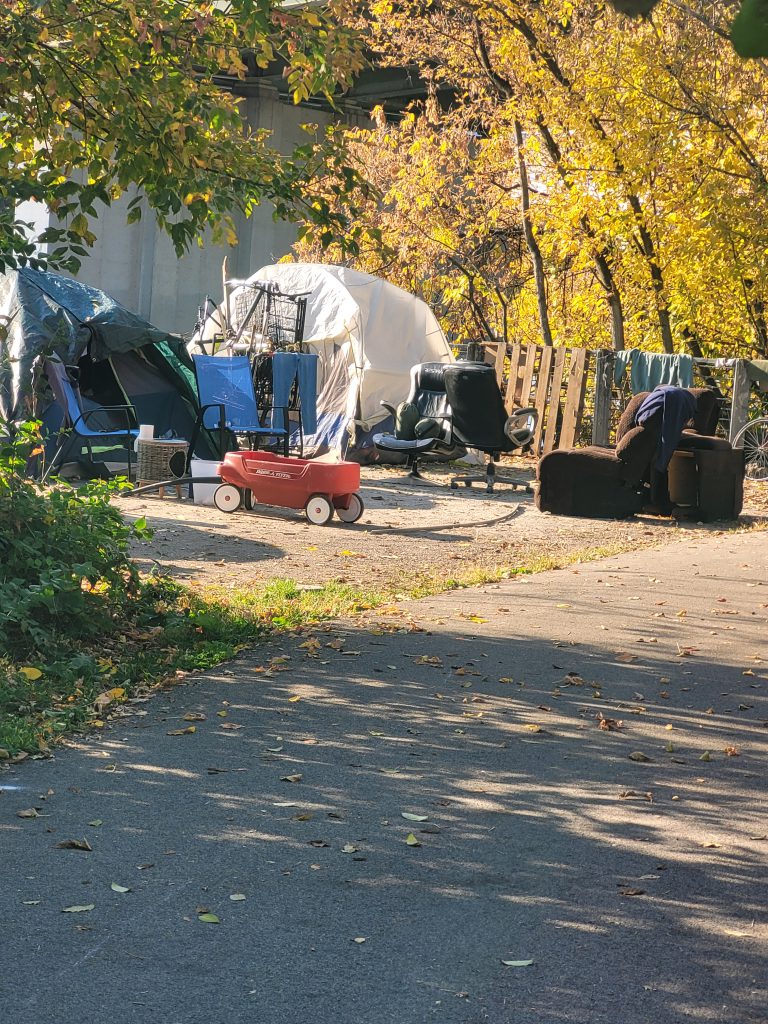
Few people support tent cities in downtown areas, but just as few support callous emptying of encampments where unhoused people have placed their scant possessions. 500 in 500 offered a different approach to this vexing problem.
Muhammad Ali Nasir (better known as Man-E) played a key role. Man-E founded an outreach program for current and former jail residents that expanded into homeless outreach in 2022 and later became part of 1Hood Media. In this role, he met with City and County leaders, insisting that before they cleaned out any encampments, they needed to give residents a viable place to go.
Man-E had been involved from start to finish with a 40-tent encampment that popped up along the Eliza Furnace Trail near downtown. “I gave the first tent to someone living there,” he said. “They’d been kicked out of a shelter. If they were going to shut down the encampment, we wanted it to happen in a dignified way.”
That’s exactly what happened in fall 2024, when the County, City, outreach workers and advocates worked together to move people inside. Man-E and other outreach workers compiled a list of the encampment residents, their living situation (i.e., whether they had a partner, a pet, or other needs) and what housing they would accept. As a placement was identified for each, Man-E helped transport their belongings to the new location. Only then was the tent marked as vacant and ready for removal.
Contrary to popular assumptions, Man-E said the majority of encampment residents were there for financial reasons, not due to mental health or substance use issues. Some had been released from jail with no local family or social support. All were happy to move into housing options that worked for them, including scattered site shelters, bridge programs and permanent housing.
“I did not always trust DHS or City government before this project,” Man-E acknowledged. “Now that I have worked closely with them to eradicate homelessness, I have seen the fruits of their labor.”
Lisa Frank, former chief operating and administrative officer for the City of Pittsburgh, highlighted the impact of 500 in 500 in enabling city government to offer a credible alternative to living unsheltered.
“People can come into a shelter through the front door, but they have to have a back door so that they can leave shelter and be properly housed,” Frank stated. “A congregate shelter with minimal privacy is not how people want to live. A lot of people won’t want to come in from the cold if they think they will end up on the top bunk in a room of 30 people for the next 365 days. With the focus on housing, we create flow in our system. Now, if someone puts up a tent, outreach workers can go out and tell them that this is not a safe place to live but that we can help them find one.
“Unhoused people can see, just like everyone else, what’s working or not working,” Frank added. “When they learn that their friends are finding credible alternatives to living alongside a trail, that changes the conversation. 500 in 500 has made it possible for us to say to people living outside, ‘Come to our shelter and we can work from there.'”
Results as of Day 500
Quantitatively, there’s no question that 500 in 500 has been a success. As of day 500 (October 18, 2025):
Forty-nine percent (273) of the units were in the private market, forty-one percent (228) were from a housing authority and the remaining 9% (52) were supportive housing.
Two hundred forty-four adults, including many who are 55+, and 102 families with children have secured housing. Most families with children had a household size of two to four people, but the initiative has found housing for families with as many as eight members.
Among single adults, the average number of exits to rental units increased 35%, from about 20 per month in the year preceding the initiative to an average of 27 per month during the initiative.
As of early November 2025, 98% of families with children and 95% of adults who leased a unit through 500 in 500 had not returned to the homelessness system.
The total number of tents along the riverfront trails and in downtown Pittsburgh reached a high of 143 on August 20, 2024; that number stood at two as of the end of October.
Northside Riverfront Trail, 2024
Northside Riverfront Trail, 2025
When the County set out to quickly house individuals staying in shelter who were assessed as relatively low-risk, they relied on a predictive risk model—the same model used to identify those eligible for permanent supportive housing. Allegheny County DHS is one of only a few governments in the world using predictive analytics to target interventions. Most systems still depend on manual, time-consuming assessment tools that are less accurate and often reinforce bias. Those approaches result in the less precise identification of target populations, thus diluting the impact of interventions. In contrast, DHS’s models have repeatedly proven to be more accurate than traditional methods and to reduce racial disparities in outcomes. This data-driven precision is a key reason for the success of 500 in 500.
Among over 400 people who leased through 500 in 500 through June 2025:
Only 6% subsequently experienced a mental health crisis
A remarkably low 1% had a mental health inpatient stay
Only 4% had more than four emergency department visits (compared with over 40% for their high-risk peers staying in shelter)
Only 1% had a booking in the County Jail
Qualitatively, participants and stakeholders have expressed appreciation for the quality and efficiency of service; the fruitful collaboration between DHS and the City and County housing authorities; the inclusion of a broad range of stakeholders concerned about the attractiveness of downtown Pittsburgh; and the innovation and decency with which Pittsburgh and Allegheny County have tackled the vexing problems of homelessness and tent encampments.
“It was a privilege to be invited to the 500 in 500 table early on,” said Matt Galluzzo, president and CEO of Riverlife. “Erin Dalton and DHS have done a brilliant job of using data to understand the problem better, advance solutions, and set an audacious goal to get the system working as it should. I commend the City and County for approaching this problem in an appropriate and dignified way. This is a great example of Pittsburghers understanding our community and rallying to support those in need.”
“It is exciting to see so many City and County departments come together to work toward the same end goal,” said Fink of Henry L. Hillman Foundation.
“500 in 500 has succeeded in getting everyone focused on moving people into housing.”
Chuck Rohrer, HACP communications director, echoed Fink’s sentiments: “The interagency cooperation is much better than before. It’s nice to see that Pittsburgh can pull together and achieve such an ambitious goal.”
“I could never have imagined a government office operating with this speed and agility, especially while relying on in-house expertise,” said Silver, the DHS technology officer. “Peers at other levels of government are often surprised by how quickly we can move and how much we do in-house.”
For ACHA’s Stephenson, the chance to deploy his agency’s resources with greater effectiveness has been rejuvenating. “This partnership is not going to end on the 500th day,” he declared. “It will absolutely continue as long as I am sitting here.”
The Allegheny County team celebrating day 500. Left to right: Ed Nusser, Director of Housing Strategy; Andrea Johnson, 500 in 500 participant; Erin Dalton, Director of Human Services; Sara Innamorato, County Executive; Lauren Connelly, Director Economic Development; Rich Stephenson, Director of Allegheny County Housing Authority.
County Executive Innamorato said, “I’m thrilled with the success of 500 in 500. Not only did we exceed our goals in terms of identifying units and housing people, we forged new partnerships and changed systems that will continue to provide lasting benefits well past day 500.”
Thank You to Our Partners
Government Partners
Allegheny County Department of Human Services
Allegheny County Economic Development
Allegheny County Housing Authority / Glenshaw Gardens
City of Pittsburgh
Housing Authority of the City of Pittsburgh
PA Housing Finance Agency
Urban Redevelopment Authority of Pittsburgh
Property Owners
Action Housing
Baltic Steel Management
Brandywine Communities
Clairton Community Properties
Hullett Properties
MS Capital Group Pittsburgh LLC
NDC Asset Management
Rising Tide Partners
Trek Development
Foundations
Buhl Foundation
Eden Hall Foundation
The Heinz Endowments
Henry L. Hillman Foundation
Richard King Mellon Foundation
Download Full Report (PDF, 150 MB)
Questions or Feedback?
We welcome your questions and suggestions. To share feedback, you can reach us at DHSResearch@alleghenycounty.us. If you’d like to stay informed, consider signing up for our newsletter. To learn how to use DHS data in your research, please visit our Requesting Data page. Thank you for your time and interest. Your engagement helps shape and improve how we share data that matters.
We invite you to explore this page and its resources to learn about two data driven models—the Allegheny Housing Assessment (AHA) and the Mental Health Allegheny Housing Assessment (MH-AHA). These are decision support tools that the Allegheny County Department of Human Services (DHS) uses to improve equity and transparency in how we prioritize placement—and ultimately improve outcomes—in housing and mental health residential services.
Allegheny Housing Assessment (AHA)
Permanent Supportive Housing (PSH) and Rapid Rehousing (RRH) are two long-term housing programs operated by Allegheny County’s Continuum of Care (CoC). Because referrals for placement in these programs exceed capacity every year, we have to prioritize for placement those who are at highest need and would benefit from it the most.
The Allegheny Housing Assessment (AHA) is a tool that uses administrative data to support decision making in this prioritization process. It is a significant improvement from the previous method of prioritization, which required the use of a lengthy questionnaire that was time-consuming to administer, distressing to applicants and unreliable. In August 2020, DHS implemented the Allegheny Housing Assessment (AHA), a model developed by a team led by Dr. Rhema Vaithianathan and partners at the Centre for Social Data Analytics↗. This model has been shown to improve equity in the allocation of housing resources. As part of DHS’s commitment to continued quality assurance, it was updated in 2025.
About the AHA Model
Agency Deploying Data-Driven Model: Allegheny County DHS Scope: Provide decision support to inform prioritization of placement in Permanent Supportive Housing (PSH) and Rapid Rehousing (RRH) Status: In Use Date of Deployment: August 2020 Last Updated: August 2025
The AHA is a decision support tool that helps DHS prioritize admissions to Rapid Rehousing (RRH) and Permanent Supportive Housing (PSH). The model assists in prioritization by identifying individuals who are at risk of a set of adverse outcomes related to homelessness.
How the AHA Model Works
The AHA is comprised of four component models that each predict a different outcome: inpatient mental health stays, four or more emergency department visits, jail bookings, and homelessness within a year of the assessment date. The first three outcomes were used to develop the November 2020 version of the model, while the homelessness component was added to the 2025 update.
The training data for the updated AHA model is comprised of 18,008 RRH/PSH assessments from 2016 through 2024. The component models are random forests tuned using subject-wise cross-validation to estimate the likelihood of their respective outcomes. These probabilities are weighted and combined to generate a 1-10 integer score, where 10 represents highest risk and 1 represents lowest risk. Read the most recent AHA methodology update here. Read the full AHA methodology report here.
AHA’s Performance
Allegheny Housing Assessment (AHA)
Outcome
Area Under the Curve (AUC)
Prevalence among AHA 10s (Positive Predictive Value)
True Positive Rate Among AHA 10s
Baseline Prevalence
Mental Health Inpatient
0.71
29%
26%
12%
Emergency Room 4+ Visits
0.66
46%
21%
24%
Jail Booking
0.72
39%
22%
16%
Any Homelessness
0.68
58%
16%
32%
While the AUC and Positive Predictive Value performance for the first three outcomes are similar in the 2020 and 2025 versions, inclusion of the homelessness component model in the 2025 update significantly improves AHA’s identification of homelessness risk, from an AUC of 0.54 to 0.68.
In addition to pre-deployment performance evaluation, the scores that are generated daily are monitored on an ongoing basis for both drift and unusual distribution.
The August 2020 AHA model was subject to a thorough fairness and equity review by Eticas, which found that there were few concerns regarding the model’s fairness across various groups. This represented an improvement in the racial equity of housing services in the County. In the process of updating AHA, we ensured that resources would continue to be allocated equitably.
The table below compares the gender and race breakdown of AHA 10s between the 2020 and 2025 models. Allocations across racial groups appear similar in the updated model, but there is a shift in allocations between genders. In the new model, more men and fewer women would be assigned housing for both singles and families. This shift is likely due to the large difference in homelessness risk between men (38% one-year homelessness risk) and women (26%). Because the updated model includes the homelessness component, it prioritizes more men for housing than the earlier version.
Gender and Race Allocations
AHA 10s, Aug. 2025 Model
AHA 10s, Nov. 2020 Model
Black
50%
46%
White
49%
48%
Female
24%
34%
Male
76%
62%
DHS will continue to advance equity and transparency in our predictive risk models/data-driven models through external audits and release of statements to the public. To learn about what DHS has already done to support equity and transparency, see Etica’s algorithmic impact assessment and DHS’s response to the algorithmic audit.
Community Input in AHA Adoption
There has been rich public engagement throughout the development of AHA, including involvement from policy makers, community groups, industry experts and the general public. Specifically, individuals experiencing homelessness, local service provider agencies, national homelessness experts, advisory boards and committees, DHS leadership, local funding agencies and foundations, and representatives from the U.S. Department of Housing and Urban Development (HUD) have all contributed to AHA’s development. Formats for engagement have included focus groups and presentations, where stakeholders could express optimism or share concerns about the model.
Community feedback surfaced concerns about the accuracy and completeness of administrative data on the homelessness population. This feedback resulted in the implementation of quality assurance protocols and alternative self-report predictive assessment tools, improvements that aim to support the assessment process but not replace clinical judgement for decision-making.
National Feedback sourced from conferences and conventions provided DHS with cross-sector expert input, including professional feedback from leading experts in fields covering data science, analytics and ethics. The insights drawn from these specialists support DHS’s mission to use predictive risk models ethically and responsibly, for the purpose of improving human service systems’ responses to evolving community needs.
DHS will continue to promote and engage in two-way communication that both centers community voices and informs staff and partners—whether it be through focus groups with people experiencing homelessness or discussions with providers. To learn about what DHS has already done, see the Focus Group Report and the Overview of Models and Implementation video.
Mental Health Allegheny Housing Assessment (MH-AHA)
Mental Health Residential (MH-Res) programs are a high-demand resource that require prioritization and waitlist management. The purpose of the Mental Health Allegheny Housing Assessment (MH-AHA) is to identify people who are at the highest risk of future mental health inpatient stays and repeated ER visits and thus most in need of MH-Res services. This model offers a low-cost and data-driven way to assess individuals in Allegheny County for their level of need to help prioritize this limited resource.
About the MH-AHA Model
Agency Deploying Data-Driven Model: Allegheny County DHS Scope: Identify individuals at high risk of negative outcomes to prioritize access to mental health residential programs Status: In Use Date of Deployment: February 2023 Last Updated: August 2025
In February 2023, DHS implemented the Mental Health – Allegheny Housing Assessment (MH-AHA), developed by a team led by Dr. Rhema Vaithianathan at the Centre for Social Data Analytics. The MH-AHA is a decision support tool that helps DHS prioritize admissions to mental health residential programs. The model assists in prioritization by identifying individuals who are at risk of a set of adverse outcomes related to mental and physical health.
How the MH-AHA Model Works
The training data for the MH-AHA model is comprised of 13,673 RRH/PSH assessments from 2016 through 2024 for people who were enrolled in Medicaid at the time of their assessment. The model is comprised of two component models; each predicts a different outcome: 1) inpatient mental health stays and 2) four or more emergency department visits within one year of assessment. The component models use DHS warehouse data to generate probabilities of their respective outcomes. These probabilities are combined to generate a 1-10 integer score, with 10 indicating highest risk and 1 indicating lowest risk.
The updated MH-AHA model was evaluated along several dimensions of performance and fairness, both in absolute terms and by comparison to the February 2023 version of the model. Model performance for the two outcomes is shown in the table below:
Mental Health Allegheny Housing Assessment (MH-AHA)
Outcome
Area Under the Curve (AUC)
Prevalence among MH-AHA 9 and 10s (Positive Predictive Value)
True Positive Rate Among MH-AHA 9 and 10s
Baseline Prevalence
Mental Health Inpatient
0.73
48%
34%
25%
Emergency Room 4+ Visits
0.78
52%
48%
18%
The area under the curve (AUC) and Positive Predictive Value (PPV) performance improved from the 2023 model to the 2025 update for both outcomes. AUCs improved from 0.64 and 0.75 to 0.73 and 0.78 for Mental Health Inpatient and Emergency Room 4+ Visits, respectively, and the PPV improved by 7 to 8 percentage points for each outcome.
In addition to pre-deployment performance evaluation, we monitor the scores that are generated, on a daily basis, for drift and unusual distribution.
While different subsets of the training set can present different levels of risk (meaning that the risk for certain subgroups can be under- or over-estimated), it is important that the model selects a treatment group that is equally at-risk across subgroups. For this reason, we performed a full equity analysis looking at the precision and recall across the sensitive categories of race and gender.
We also examined how the model update might change the distribution of resource allocations. The table below compares the gender and race breakdown of MH-AHA 9s and 10s between the 2023 and 2025 models. Allocations across racial and gender groups are nearly the same in the updated model, which indicates that there has not been a shift in equity.
Gender and Race Allocations
MH-AHA 9-10s, Aug. 2025 Model
MH-AHA 9-10s, Feb. 2023 Model
Black
50%
52%
White
50%
44%
Female
46%
48%
Male
53%
52%
DHS will continue to advance equity and transparency around use of predictive risk models/data-driven models through external audits and by releasing statements to the public. To learn about what DHS has already done to support equity and transparency, see Etica’s algorithmic impact assessment and DHS’s response to the algorithmic audit.
Community Input in MH-AHA Adoption
There has been broad public and professional engagement in the development of MH-AHA:
Feedback provided from AHA’s engagement process directly informed the development of MH-AHA. The cross-sector input gathered for AHA from experts in multiple fields established the foundation that DHS carried forward to implement MH-AHA. Experts included researchers, machine learning experts, homelessness policy and program administration experts, cyber law experts, ethicists, privacy experts and representatives from HUD. To learn more about the community’s involvement in AHA (and thereby MH-AHA), please review the section on Community Input in AHA Adoption.
MH-AHA also included input from providers, DHS staff and local judges, who recognize that the availability—or lack thereof—of residential mental health housing is an important consideration when making crucial service and/or judicial decisions.
These elements of MH-AHA’s development ensure both system-level and community-based considerations shape MH-AHA’s design and use.
DHS will continue to promote and engage in two-way communication that both centers community voices and informs staff and partners—whether it be through focus groups with people experiencing homelessness or discussions with providers. To learn about what DHS has already done, see the Focus Group Report and the Overview of Models and Implementation video.
MH-AHA Publications & Resources
Mental Health Allegheny Housing Assessment (MH-AHA)
We welcome your questions and suggestions. To share feedback, email us at DHSResearch@alleghenycounty.us. If you’d like to stay informed, consider signing up for our newsletter. To learn how to use DHS data in your research, please visit our Requesting Data page. Thank you for your time and interest. Your engagement helps shape and improve how we share data that matters.
The Allegheny County Department of Human Services (DHS) partnered with Pittsburgh Regional Transit (PRT) to launch a new transportation assistance program in November 2022 called the Discounted Fares Pilot. This program offered free and reduced-price PRT rides for county residents ages 18 to 64 who receive Supplemental Nutrition Assistance Program (SNAP) benefits, along with their 6- to 17-year-old children. The fare discounts were allocated using a lottery. Each household in the pilot was randomly assigned to one of three groups, each with equal probability. One group received unlimited free PRT trips, a second group received a 50% discount on all PRT trips, and a third group received no discount. The fare discounts lasted 16 to 19 months for the free-fare and half-fare groups.
Key Takeaways
The Pilot began with strong enrollment—over 14,000 people. A total of 9,544 adults and 4,928 children enrolled in the Pilot during the three-month open enrollment period. The majority of adult participants were female (72%) and Black (59%). Participants reported taking an average of ten PRT trips per week and spending an average of nearly $30 on public transportation per week at the time they enrolled in the Pilot.
Free fares increased public transit ridership. On average, participants in the free-fare group took 1.48 more trips per week—a 43% increase—compared to those who paid regular price for their trips. In contrast, transit usage among participants who received half-priced fares was not statistically different from those who paid regular price for their trips.
Fare discounts eased financial hardships. Near the end of the discount period—around 15 months into the pilot program—recipients of free fares reported spending $17.09 less per week on public transit compared to participants who paid full price for their transit usage. Participants paying half-priced fares reported spending $5.64 less per week on public transportation than participants who paid full price for each ride.
Among participants who began the study without a job, free fares led to meaningful gains in employment and income. Over the first year and a half of the program, unemployed individuals who received free transit were 6% more likely to secure paid work than those who paid full price. Free-fare recipients also earned nearly $2,850 more—a 28% increase in earnings—compared to participants who covered their own transit costs. These findings suggest free public transit can increase financial stability and employment opportunities for low-income residents in Allegheny County.
The short duration of the fare discounts may have limited their impact on other social and educational outcomes. The study found small and statistically insignificant impacts on healthcare utilization and criminal justice involvement (including appearances in court). Fare discounts had no detectable impact on school attendance among children who attend Pittsburgh Public Schools.
How DHS Uses This Information
DHS has used the results from this pilot to inform the design and implementation of a longer-term program called AlleghenyGo, which offers a 50% PRT discount for working-age county SNAP beneficiaries and their children. Click here to learn more about AlleghenyGo.
We welcome your questions and suggestions. To share feedback, you can reach us at DHSResearch@alleghenycounty.us. If you’d like to stay informed, consider signing up for our newsletter. To learn how to use DHS data in your research, please visit our Requesting Data page. Thank you for your time and interest. Your engagement helps shape and improve how we share data that matters.
The Allegheny County Department of Human Services (DHS) actively monitors the size, location and conditions of tent encampments in areas frequented by people without housing (e.g., Downtown Pittsburgh and the riverfront trails).
What data is available?
The encampment survey dashboard covers encampment data for three areas – the North Side trail, South Side trail, and areas in Downtown Pittsburgh with visible homelessness. Surveyors document information in an online survey tool, including the location of the encampment, the number of tents/structures and whether any immediate action is needed. The datahelps DHS track changes in encampment conditions, size, and location over time. The dashboard displays encampment counts from May 2023 to the present, and its data updates weekly.
This data does not attempt to calculate the number of people using tent encampments.A tent or makeshift structure may house one or more people. It may also be vacant, shared, borrowed or used for storage. This dashboard’s scope is confined to specific locations with visible homelessness around Pittsburgh.It does not include data on other encampments that may be hidden from public view butstill known to DHS or other outreach providers.
How does DHS use the dashboard data?
This information is reported weekly to DHS, the City of Pittsburgh, and homeless outreach and partner organizations, to ensure that they have the best information available for decision-making and to provide a timely response to any issues that may impact the safety of people using and/or sleeping in these public spaces. In addition to using these data to drive real-time action, trends in the data help quantify community needs, including emergency shelter demand and crisis response planning. This data – crossed with other data sources about the number of people experiencing homelessness – provides measurable outcomes to understand the extent to which investments in housing and supportive services impact visible homelessness.
DHS is aware that the presence of tent encampments can generate strong feelings in the public – from concern for health and safety to discomfort or fear. However, homelessness is often a negative outcome of economic hardship, systemic inequities and trauma – outcomes many people experience. Therefore, DHS encourages dashboard viewers to interpret the data with care. Interpretations made from this data should remain mindful of peoples’ lived experience.
This dashboard has the opportunity to influence public policy, inform public safety, enhance outreach responses and support broad efforts to improve the lives of individuals in the community. If you are interested in learning more about housing instability and homelessness, we invite you to reviewadditional related dashboards and reports on homelessness and shelters.
We welcome your questions and suggestions. To share feedback, you can reach us at DHSResearch@alleghenycounty.us. If you’d like to stay informed, consider signing up for our newsletter. To learn how to use DHS data in your research, please visit our Requesting Data page. Thank you for your time and interest. Your engagement helps shape and improve how we share data that matters.
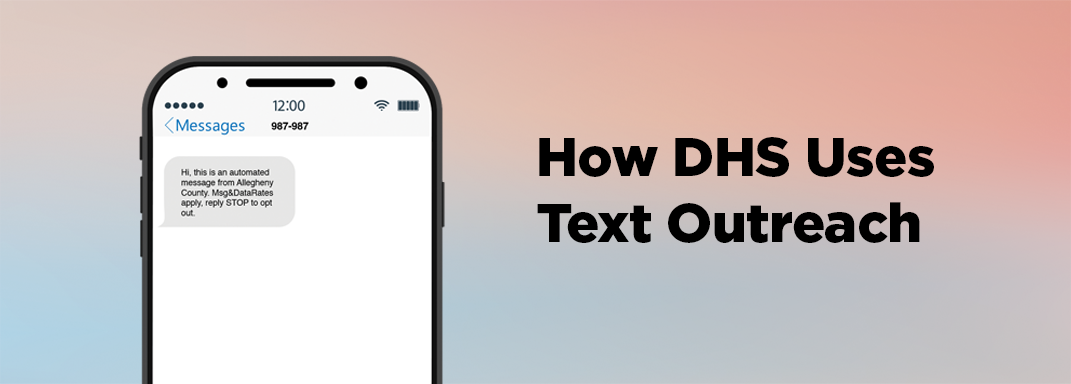
The Allegheny County Department of Human Services (DHS) engages clients and others who interact with DHS programs in a variety of ways: regular roundtables/cabinets (e.g., Children’s Cabinet); town halls and community forums; social media (e.g., Facebook and LinkedIn); and the Director’s Action Line (DAL). In 2018, DHS expanded its public engagement strategy to include SMS text messaging (texting), a tool that is convenient for recipients and allows DHS to scale up communication with clients and other Allegheny County residents.
How does DHS use text outreach?
DHS uses text outreach in a variety of ways, including collecting feedback after a service touchpoint, increasing program engagement, recruiting for paid research opportunities, and providing timely alerts. Text messaging has allowed DHS to connect clients to resources at scale, and to solicit feedback from clients who would likely never otherwise have the time or opportunity to share their feedback.
What data is available?
The data brief provides more information about the communication strategy and descriptive analytics from 2018 to 2022. The interactive dashboard, which is updated daily, allows users to drill down to individual text campaigns to understand the purpose, the number of messages sent, and the demographics of people who were contacted.
Terms and Conditions
This service is used by the Allegheny County Department of Human Services to send you notifications about publicly funded services. You can cancel this service at any time. Just text “STOP” to 987987. After you send the message “STOP” to us, we will send you a reply message to confirm that you have been unsubscribed. After this, you will no longer receive messages from us. If you want to join again, just text “START” to 987987, and we will start sending messages to you again. If at any time you forget what keywords are supported, just text “HELP” to 987987 After you send the message “HELP” to us, we will respond with information about the program. Message frequency varies. Carriers are not liable for delayed or undelivered messages. As always, Message and Data Rates May Apply for any messages sent to you from us and to us from you. If you have any questions about your text plan or data plan, it is best to contact your wireless provider. For all questions about the services provided by this short code, you can contact us at DHS-Research@alleghenycounty.us
Pittsburgh-Allegheny County is one of eight sites participating in the Community Choice Demonstration (CCD) – a large-scale, multi-site randomized controlled trial to test the efficacy of offering housing mobility-related services to families with children in the Housing Choice Voucher (HCV) program. The CCD builds on prior research showing that growing up in lower-poverty neighborhoods increases children’s academic achievement, long-term earnings as adults, and selected improved health outcomes for children and adults.
What is this report about?
This Rapid Cycle Evaluation is the first report assessing the early implementation of the Demonstration and capturing the initial impact and costs of comprehensive mobility-related services (CMRS). The report provides preliminary findings on the locational outcomes for 596 HCV families with children who enrolled in the first 8 months of the 6-year Demonstration through March 2023. This is the first of a series of reports expected over the next eight years detailing progress of the Demonstration, which began in August of 2022 and ends in October 2028.
What are the takeaways?
An analysis of 12 months of data indicates that the Demonstration is having a statistically significant, positive impact on moves to low-poverty, high opportunity areas. Almost 24% of HCV families with children who received CMRS moved to an opportunity area, compared to 4% percent of HCV families in the control group. The offer of CMRS resulted in a nearly 20 percentage point increase in the share of families moving to an opportunity area within 12 months of study enrollment.
From May through August 2024, Allegheny County Department of Human Services (DHS) engaged in a comprehensive needs assessment. The purpose of the assessment was to determine how DHS can best address the needs of individuals and families living in poverty and promote stability and economic security using Community Service Block Grant (CSBG) funds and other flexible funding across the agency. The assessment included collection and analysis of qualitative and quantitative data from community members and service providers.
Despite a decrease in the overall poverty rate, there remain deep disparities in poverty by demographic groups. Black people, women with children and people with less than a high school diploma experience poverty at twice to three times Allegheny County’s rate.
Finding job opportunities was the number one challenge reported by survey respondents seeking employment. Additional barriers to employment include transportation and resumé/application preparation.
Workforce participant engagement for those receiving SNAP and TANF (i.e., those with low income, for whom relevant data are available) increased from 2021 to 2022, possibly explained by COVID-related participation extensions. The demand for job readiness/training programs among this population, particularly for SNAP recipients who are female and Black, is expected to increase further as SNAP work requirement waivers expire in 2025.
The Allegheny County Department of Human Services (DHS) funds programs to assist young adults who are transitioning out of the child welfare system (also known as transition-aged youth) to secure employment, education, housing, behavioral health services, financial advice and more. Despite these service offerings, transition-aged youth have higher rates of homelessness, substance use, mental health challenges and incarceration, as well as lower rates of high school graduation compared with people who were not involved with the child welfare system. While targeted services are important, some human service needs result from poverty, which can be mitigated by providing direct financial assistance.
What is this report about?
In the summer of 2023, DHS launched a direct cash support program called Cash Assistance for Allegheny Young Adults (CAAYA), which provided a one-time payment of $4,000 to young adults, ages 18 through 22, with a history in the child welfare system, who were experiencing homelessness or were young parents who had an open case with Allegheny County’s child welfare office. In this report, we present a mixed-methods approach to evaluating the impact of CAAYA, including longitudinal surveying, a quasi-experimental analysis of administrative data in the Allegheny County Data Warehouse, and semi-structured interviews with cash recipients.
What are the takeaways?
CAAYA recipients demonstrated significant financial need. At the launch of the program, only 35% reported being currently employed and only 29% reported being in school either full-time or part-time. Those who had some form of formal employment in the 12 months before the program had mean annual earnings of $10,174. Twenty-eight percent had one or more children.
CAAYA recipients also lacked financial support within their community. Two-thirds of recipients reported not knowing anyone who would lend them $500 in a time of crisis.
Overall, the program encouraged about 100 individuals to open a bank account. Seventy-five percent (n = 774) of recipients chose to receive the money via bank account transfer and 25% via a virtual gift card.
Recipients used the cash assistance quickly. On average, $2,769 of the $4,000 was spent within the first month.
Car-related expenses ranked as the number one item for planned expenditures, and there was a 41% relative increase in car ownership three months after receiving the money.
The program improved self-reported well-being after receiving financial assistance, but the effects faded in the subsequent months.
CAAYA recipients increased their use of mental health outpatient therapy by 7% compared to a control group of individuals who were narrowly ineligible for the program. There was no change in utilization of crisis and inpatient services. In contrast to self-reported well-being, the program’s impact on usage of outpatient mental health services persisted for at least eight months after receiving funds.
How is this report being used?
As a result of this program, we are exploring additional opportunities to leverage cash assistance with this population to increase engagement in holistic supports and services. We are also considering longer-term programs with more frequent, smaller payments to targeted populations. For future programs, we hope to receive state waivers for the impact of cash assistance on public benefits, especially if a program is designed to include ongoing payments.
For other local governments or providers who are considering cash assistance programs, we hope this report serves as a resource for program design and evaluation. Local governments should note that the success of the CAAYA program would not have been possible without our partner organizations. Trust in government significantly impacts the accessibility of services, particularly for marginalized communities. When first hearing about the cash assistance, many individuals who were eligible to receive the money thought that it was a scam. This skepticism was eased by having multiple trusted intermediaries ensure that it was a real program and that they should apply.
The Allegheny County Department of Human Services (DHS) partnered with Pittsburgh Regional Transit (PRT) to launch a transportation assistance program called Allegheny Go. This program offers half-price PRT rides for county residents ages 12 to 64 who receive Supplemental Nutrition Assistance Program (SNAP) benefits, and do not receive any other transit fare discounts.
Allegheny Go builds on the success of the Allegheny County Discounted Fares Pilot Program, which ran from November 2022 through June 2024.
This dashboard describes the application process and reports on application statistics and participant demographics.
How is this dashboard being used?
DHS has set a goal of enrolling 15,000 participants in Allegheny Go. This dashboard tracks progress towards that goal. Staff monitor how many applications are received, how many are eligible, and make sure eligible participants receive their discounts.