The Allegheny County Jail Collaborative

Current Information

ACJC 2026 Strategic Plan

The Allegheny County Jail Collaborative (ACJC) is an alliance of government agencies and nonprofit groups dedicated to improving community safety and reducing recidivism by providing evidence-based, quality programs and services that increase positive outcomes and successful community reentry for people in the Allegheny County Jail (ACJ).

The ACJC supports strategic vision setting, gap analysis, program development and monitoring of key initiatives within the Jail, as well as cross-system improvement efforts related to diversion and post-release interventions. Many community and specialty providers and/or volunteer organizations offer in-Jail and community-based programs and services; together, these form a continuum of support designed to create a positive learning environment for people while in the Jail and—for many—when they return to their community. 

The Allegheny County Department of Human Services (ACDHS) invites you to explore these resources to learn about the ACJC and its efforts to improve services, supports and outcomes for everyone in the ACJ and those who continue to receive support to ensure successful reentry.

Background

For more than 25 years, the ACJC has influenced system change and implemented evidence-based programming to achieve its mission of increasing community safety and reducing recidivism for people involved in the criminal-legal system in Allegheny County. Over the years, ACDHS, the Fifth Judicial District including Adult Probation and Pretrial Services, and the ACJ have supported the work of the ACJC with funding from sources including ACDHS, local and national foundations, and federal and state grants. 

A revisioning process, based on years of experience, research, expert and community input, and current realities about the criminal-legal system led to the development of the 2026 ACJC Strategic Plan (PDF, 200KB). We hope you will read this report and refer to the wealth of information about the ACJC available at Allegheny County Analytics.

Key Takeaways

  • Booking and Release Rates: An average of 40-50% of individuals brought to the jail are booked; the rest are released to the community pending resolution of their case
  • Average Daily Jail Population: From July 8, 2023 through July 6, 2026, the ACJ held an average of 1,904 individuals each day. 
  • Booking Status of Individuals: Only a small percentage of the ACJ population is serving a sentence.
    • 47% are awaiting trial
    • 36% are being held on a County or PA probation detainer, meaning they are alleged to have violated terms of their probation
  • Negative Consequences of Incarceration: According to the Harvard Kennedy School Program in Criminal Justice Policy and Management, even one day in jail can have devastating negative consequences and result in poor outcomes on a wide range of measures.
    • This highlights the importance of doing everything possible to avoid delays in case processing and to provide opportunities for training, education, programming, behavioral health treatment and supportive transition back into the community for everyone in the ACJ, regardless of their length of stay. 
  • 2026 ACJC Strategic Priorities: The 2026 ACJC Strategic Plan focuses on the following priorities:
    • Diversion and Front-End Supports to safely reduce the ACJ population and the length of time in ACJ for those who are awaiting hearings, competency restoration or sentencing
    • Programming and Service Coordination based on individual need, length of stay and risk of return
    • Transition and Release Coordination to support smooth exit transition for everyone entering the ACJ
  • ACJC Expenditures: In Fiscal Year 2025-2026, ACDHS spent more than $11 million on ACJC administration, programming and provider contracts. 

Resources

On this page you will find resources spanning almost 20 years, with information about ACJC programs, strategies and evaluations.

Dashboard

Allegheny County Jail Population Management Dashboard

Strategic and Annual Plans

Allegheny County Jail Collaborative 2016-2019 Strategic Plan (PDF, 800KB)

Allegheny County Jail Collaborative Annual Report: 2018-2019 (PDF, 800KB)

Allegheny County Jail Collaborative Annual Report, 2017-2018 (PDF, 900KB)

Allegheny County Jail Collaborative Annual Report: 2016-2017 (PDF, 900KB)

Allegheny County Jail Collaborative Annual Report: 2012-2013 (PDF, 200KB)

Allegheny County Jail Collaborative Annual Report: 2011-2012 (PDF, 50KB)

Allegheny County Jail Collaborative Annual Report: 2010-2011 (PDF, 60KB)

Analytics and Narrative Reports

Narrative Report–The Bridge to Home: The Allegheny County Jail Collaborative’s Family Support Initiative (PDF, 900KB)

Narrative Report (May 2013)–Stories of Transition: Men and Women in the ACJC Reentry Program (PDF, 400 KB)

Narrative Report (Oct. 2013)–Stories of Transition: Men and Women in the ACJC Reentry Program Part 2 (PDF, 200KB)

Data Brief: Behavioral Health Services in the Allegheny County Jail 2014 (PDF, 2.5MB)

Evaluations

Urban Institute Evaluation of the ACJC Reentry Program 2014: : Findings and Recommendations (PDF, 900KB)

University of Pittsburgh Overview Report of the Allegheny County Jail Collaborative Evaluation Findings 2008 (PDF, 400KB)

How We Use This Information

Data-informed decision making continues to drive the ACJC’s focus and strategic planning. ACDHS and the ACJC will use dashboards and evaluations to monitor outcomes and drive system improvement.

What’s Next

Monitoring the progress and focus of the ACJC, the impact of its strategies on the ACJ and Allegheny County populations, and the fiscal and societal impact of its work remain an ongoing priority of both ACDHS and the ACJC.

Questions or Feedback?

We welcome your questions and suggestions. To share feedback, you can reach us at DHSResearch@alleghenycounty.us. If you’d like to stay informed, consider signing up for our newsletter. To learn how to use DHS data in your research, please visit our Requesting Data page. Thank you for your time and interest. Your engagement helps shape and improve how we share data that matters.

Web Accessibility Statement

If you encounter any accessibility issues, have difficulty accessing any digital content, or require information presented on a website in an alternate format, please contact the ADA Coordinator or submit a concern through the Accessibility on Allegheny County-owned Websites form.

Allegheny Prenatal to Three Dashboard

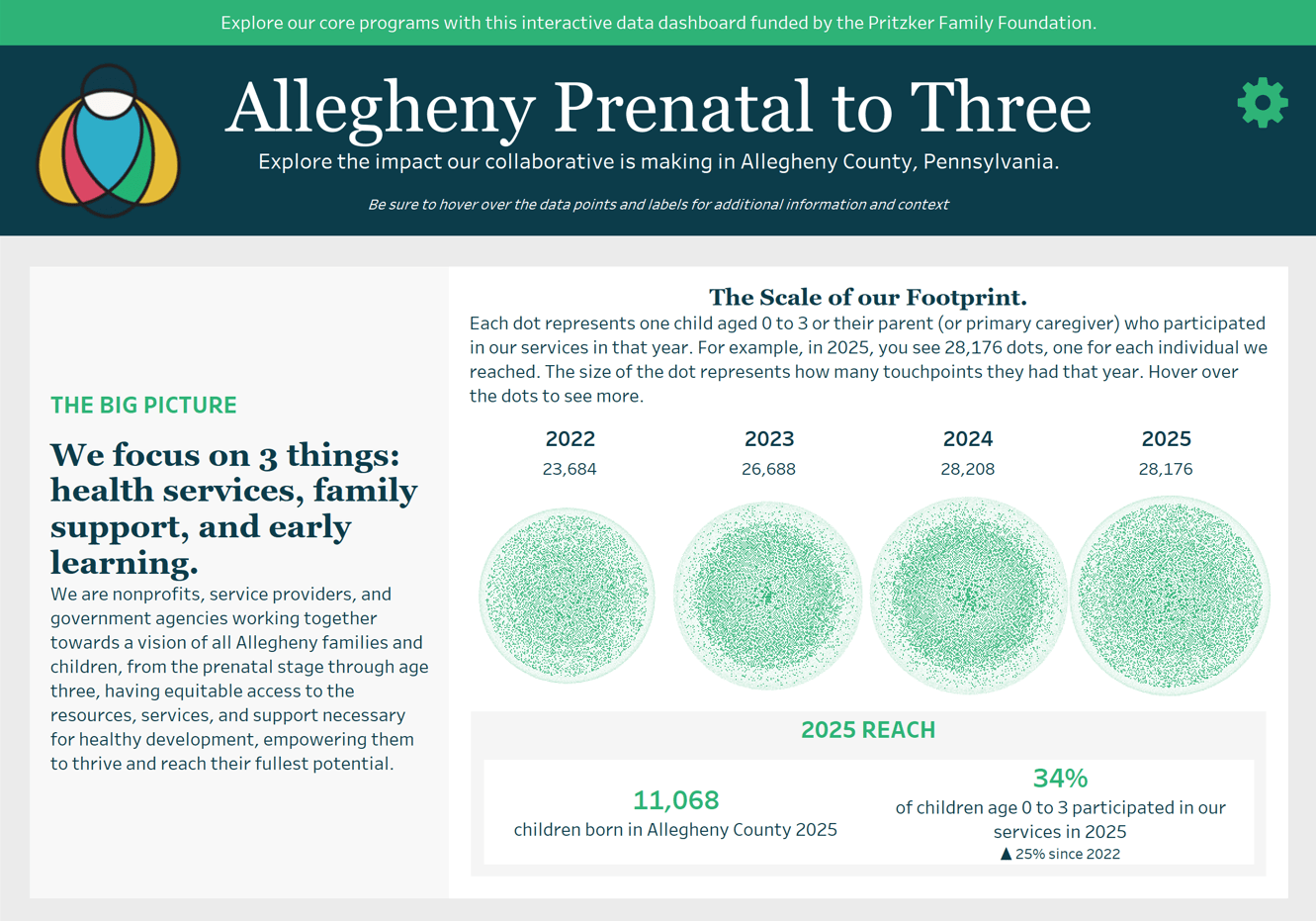
Allegheny Prenatal to Three (PN3) is a countywide collaborative that brings together public agencies, service providers, community organizations and other partners to strengthen the network of services available to families during pregnancy through a child’s first three years of life. The Allegheny Prenatal to Three dashboard uses Allegheny County data to present metrics on the collaborative’s reach and impact in health services, family support and early learning.

Visit the Allegheny Prenatal to Three Impact webpage to explore the dashboard and learn about relevant programs and services PN3 covers.

Questions or Feedback?

We welcome your questions and suggestions. To share feedback, you can reach us at DHSResearch@alleghenycounty.us. If you’d like to stay informed, consider signing up for our newsletter. To learn how to use DHS data in your research, please visit our Requesting Data page. Thank you for your time and interest. Your engagement helps shape and improve how we share data that matters.

Web Accessibility Statement

If you encounter any accessibility issues, have difficulty accessing any digital content, or require information presented on a website in an alternate format, please contact the ADA Coordinator or submit a concern through the Accessibility on Allegheny County-owned Websites form.

In the last eight years, the number of Americans experiencing homelessness in the United States has increased by 40%, even as the supply of subsidized housing has doubled. Research shows that housing programs effectively support housing stability. However, system-level outcomes depend on whether housing reaches people likely to exit shelter quickly or those likely to experience longer-term housing instability. Systems that prioritize people with shorter expected stays reduce homelessness less than when they prioritize people facing longer-term instability. Using administrative data from Allegheny County, this policy brief and working paper examine how often housing does not reach those with the greatest need, identify and characterize those who do not receive services, and outline how to recognize these individuals before their homelessness becomes long-term.

Key Results

Using administrative data from Allegheny County, we have developed a predictive model that identifies—at the time of shelter entry—individuals likely to experience an extended shelter stay.

  • Most shelter residents exit shelter on their own within weeks after starting their shelter stay.
  • Among the highest-risk individuals flagged by the model, over 40% go on to experience extended homelessness—over three times the baseline rate.
  • Allocating housing to individuals or families at the highest risk of prolonged shelter stays would prevent approximately 2.4 times more shelter days per unit than allocating to the average shelter resident.
  • Making housing allocations based on the predictive model rather than current federal prioritization criteria would prevent 120% more shelter days.
  • Shifting from retrospective to prospective targeting could substantially reduce overall homelessness without expanding the subsidized housing supply.

Why This Matters and What’s Next

Homelessness remains difficult to solve. These data highlight a core challenge: most individuals resolve occurrences of homelessness quickly, while housing supports take time to deploy.

Without thoughtful allocation, resources do not reach people with the greatest need. Allegheny County continues to develop approaches that prioritize resources for individuals at highest-risk. This principle already guides ACDHS programs such as 500 in 500 and the Allegheny Housing Assessment, which have successfully prioritized individuals for housing in times of acute need.

Questions or Feedback?

We welcome your questions and suggestions. To share feedback, email us at DHSResearch@alleghenycounty.us. If you’d like to stay informed, consider signing up for our newsletter. To learn how to use ACDHS data in your research, please visit our Requesting Data page. Thank you for your time and interest. Your engagement helps shape and improve how we share data that matters.

Pittsburgh-Allegheny County is one of eight sites participating in the Community Choice Demonstration (CCD) – a large-scale, multi-site randomized controlled trial to test the efficacy of offering housing mobility-related services to families with children in the Housing Choice Voucher (HCV) program. The CCD builds on prior research showing that growing up in lower-poverty neighborhoods increases children’s academic achievement, long-term earnings as adults, and selected improved health outcomes for children and adults.

What is this report about? 

This Rapid Cycle Evaluation is the first report assessing the early implementation of the Demonstration and capturing the initial impact and costs of comprehensive mobility-related services (CMRS). The report provides preliminary findings on the locational outcomes for 596 HCV families with children who enrolled in the first 8 months of the 6-year Demonstration through March 2023. This is the first of a series of reports expected over the next eight years detailing progress of the Demonstration, which began in August of 2022 and ends in October 2028.

What are the takeaways?

An analysis of 12 months of data indicates that the Demonstration is having a statistically significant, positive impact on moves to low-poverty, high opportunity areas. Almost 24% of HCV families with children who received CMRS moved to an opportunity area, compared to 4% percent of HCV families in the control group. The offer of CMRS resulted in a nearly 20 percentage point increase in the share of families moving to an opportunity area within 12 months of study enrollment.

Allegheny County residents face significant challenges in accessing behavioral health services, an issue highlighted by recent studies and surveys. Notably, a Countywide survey revealed that 42.7% of respondents believe improving access to mental health care, particularly for young people, should be a priority. This finding is supported by research from the University of Pittsburgh, which documented long wait times for appointments and challenges in connecting with providers. These issues stem from a critical shortage of behavioral health professionals and are compounded by time-consuming provider search processes.

In response, the Allegheny County Department of Human Services (DHS), along with Community Care Behavioral Health (CCBH), the County’s behavioral health managed care organization, are pursuing a series of investments and initiatives aimed at addressing these barriers and increasing service availability.

To improve access and reduce wait times, DHS and CCBH are focusing on:

  • Creating visibility into appointment availability so clients and providers spend less time searching for services.
  • Supporting the behavioral health workforce through loan repayment and cohort-based training programs to increase the number of providers.
  • Investing in community-based mental health supports to offer additional options outside the traditional system.
  • Expanding access to proven treatments like medication-assisted therapy for opioid addiction, cognitive behavioral therapy and group therapy.
  • Augmenting clinical decision-making to ensure those who need help most get it quickly
Current information

Since 2016, the Allegheny County Department of Human Services (DHS) in Pennsylvania has utilized the Allegheny Family Screening Tool (AFST), which assists child welfare call screening caseworkers in their assessment of general protective service (GPS) referrals regarding potential child maltreatment.

What is this report about?

This report reviews the research evidence on algorithms in child welfare, specifically focusing on the causal impacts of the AFST and comparable predictive risk models (PRMs). It begins by summarizing the influence of these tools on child welfare decisions. The report then explores the discrepancies between perceived and actual effects of these models, highlighting the importance of bridging the gap between perception and reality to alleviate concerns and maximize the effectiveness of these tools.

What are the takeaways?

The impacts of predictive risk models in child welfare must be compared with alternative approaches to augmenting call screening caseworker decision-making. Traditional risk assessments in child welfare have been largely manual, prone to inconsistencies, and often omit critical information. Before implementing the AFST, Allegheny County did not employ any structured risk assessment.

The main conclusions from recent research on the AFST are:

  • The AFST changed the composition of investigated referrals. The introduction of the AFST decreased the probability of investigation for referrals with low risk of removal and increased the probability of investigation among referrals with high risk of removal. The introduction of the AFST also reduced the racial gap in investigation rates, particularly among higher risk referrals.
  • The AFST is reducing, not increasing, racial disparities. Researchers found that the introduction of the model reduced racial disparities in investigation rates across AFST scores, although the size and precision of the reduction varied. The AFST reduced the racial disparity in investigation rates for the highest risk referrals by 83%, from 10.6% to 1.8%. The researchers estimated that the AFST reduced the Black–White gap in removal rates of screened-in referrals by 73%, from 4.3% to 1.2%.
  • Screeners use the algorithm but with caution. Researchers found that call screening case workers are integrating information from the AFST effectively, aligning their decisions more closely with predicted removal risk compared with the period before the tool’s introduction. The tool is seen as a helpful source of additional information rather than a replacement for professional judgment. 

How is this report being used?

The application of algorithms to support decision-making, especially in sensitive areas like child welfare, mandates high transparency. It is critical that the complexities of predictive risk models are communicated clearly to all stakeholders to maintain trust and prevent misuse. DHS is committed to keeping the public informed about the use and impact of algorithms at the Department and draw upon current research to shape the implementation of these tools in the field.

Read more about AFST here.

Reports

In 2018, the Allegheny County Department of Human Services entered into a formal data use agreement (DUA) with UPMC Health Plan. The purpose of the agreement is to improve care for shared clients. The report — Leveraging Data to Support Health Equity in an Integrated Delivery and Finance System — details how UPMC leveraged data sharing, spotlights associated outcomes and suggests future directions for data practices in healthcare settings.

Social determinants of health (SDOH) are non-medical factors—such as housing, food security, and social support—that significantly affect health, well-being and quality of life. Because these factors often remain unknown within healthcare systems, the University of Pittsburgh Medical Center (UPMC) and the Allegheny County Department of Human Services (DHS) integrated healthcare and human services data to bridge the gap between medical and non-medical information. Their collaboration in data-sharing supports holistic, equitable care and underscores the role of informed system design in improving health outcomes.

View the report to learn how collaboration between DHS and UPMC strengthen social supports and advance health equity.

Key Takeaways:

  1. Needs Identification: Screening found unmet social needs for more than one-third of women.
  2. Connecting people to support: Providers linked over 700 individuals with essential social services and support.
  3. Cross-sector impact: Coordination across systems identified 281,000 shared clients and resulted in enhanced care management for 100 adult Medicaid/Special Needs Plan members.

Questions or Feedback?

We welcome your questions and suggestions. To share feedback, you can reach us at  DHSResearch@alleghenycounty.us. If you’d like to stay informed, consider  signing up for our newsletter. To learn how to use DHS data in your research, please visit our  Requesting Data page. Thank you for your time and interest. Your engagement helps shape and improve how we share data that matters.

In 2022, staff at the Urban Institute partnered with the Allegheny County DHS and the Western Pennsylvania Regional Data Center (WPRDC) to pilot synthetic data generation at the local level, to help understand the unique challenges that might face state and local governments in generating synthetic data. Each record in the synthetic dataset represents a simulated individual, or record, who received at least one service from the Allegheny County DHS in 2021. The synthetic data were designed such that records aggregated by service represent the original data. Read more here about synthetic data.

Why create a synthetic dataset?

The Department of Human Services (DHS) in Allegheny County, Pennsylvania, serves one in five residents of the county every year through child welfare services, behavioral health services, aging services, developmental support services, homeless and housing supports, and family strengthening and youth supports. In the process, data are collected about these services and the population using them. These data are integrated at the individual level to allow for better care coordination, operational improvements, and program evaluation. Because of the dataset’s sensitive nature, it cannot be widely shared at an individual level, so synthetic data are used in the real dataset’s place—allowing the data to be publicly shared and helping stakeholders, including researchers, service providers, and members of the public, understand these populations better.

From June 2018 to December 2020, the Urban Institute conducted a systemwide assessment of the system response in Allegheny County, PA to intimate partner violence (IPV) to better understand the system as a whole and operations of some key agencies

What is this report about ?

Urban Institute presents the findings from their systemwide assessment. The goals of this assessment were to 1) examine how IPV cases enter the justice and child welfare systems in Allegheny county, 2) analyze agencies’ processes for responding to IPV and 3) recommend ways the county can improve responses to IPV.

What are the recommendations?

  • Have county leaders prioritize IPV
  • Shift the focus from case outcomes to people’s experiences, especially during early encounters with formal services.
  • Reinstate and sustain IPV-focused fatality reviews and ensure they embrace a non-blaming culture.
  • Establish a specialized IPV unit in the Allegheny County Public Defender office
  • Differentiate IPV from DV throughout all systems.
  • Record survivor information consistently and securely share it when possible.
  • Prioritize and improve referrals to batterers’ intervention programs
  • Create a mechanism to consistently track aggressors’ and survivors’ experiences at system entry points.


How is this report being used?

The county executive and Mayor of the City of Pittsburgh created an IPV Reform Leadership task force in May 2022 to actively work on addressing these recommendations and improving the system.

In July 2013, the Center for the Study of Social Policy (CSSP) and the Allegheny County Department of Human Services (DHS) launched a partnership to better support child welfare-involved youth achieve healthy sexual and identity development. This institutional analysis prepared by CSSP used data analysis, case reviews, and interviews to understand current experiences of LGBTQ+ children and families who interact with child welfare as well as cultural and practice changes that have occurred since the initiative began.

Click here to read the report.

How is the Allegheny County Department of Human Services (DHS) able to link data across programs and with providers, given privacy law restrictions?

Erin Dalton, Director of DHS, and Brian Bell, a supervisor and privacy officer, share their insights on the Gov Innovator podcast. Hosted by Andy Feldman of the Brooking’s Institution, the podcast shares insights and strategies from leaders in the public sector. This talk builds on an earlier conversation with Dalton about the Data Warehouse.

Click here to access the interview.

U.S. Government Accountability Office

The U.S. Government Accountability Office examined four innovative data sharing practices (including DHS’s) to determine (1) how selected states or localities have shared data across programs to improve the administration of human services, (2) challenges state and local human services agencies face in balancing privacy protections with greater data sharing, and (3) actions that the federal government could take to help address these challenges.

Click to read the full report.